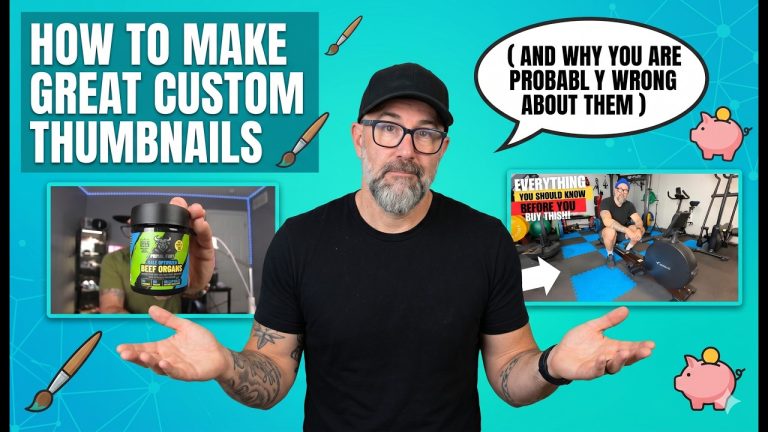
Haley asked a great question: do custom thumbnails on Amazon influencer videos actually matter, or are we all just doing extra work? Claire did an analysis that suggested they don’t move the needle. I love Claire and everything she does, but I disagree with her on this one, and I’ve got data, a little math, and a few years of talking to top earners to back it up. Here’s my case.
In This Article
- What the Data Actually Says
- The 5 Percent Rule
- Why You Cannot Start Later
- What a Custom Thumbnail Actually Means
- How My Thumbnails Have Evolved
- Product Front and Center
- What the Biggest Earners Are Doing
- Eye-Catching Is Not the Same as Salesy
What the Data Actually Says
There are three data points I lean on here. First, another creator ran an analysis last year and found the opposite of Claire’s result: a measurable correlation and improvement when custom thumbnails were used. Second, YouTube did their own study a couple of years ago and found roughly 90 percent of their top-performing videos used custom thumbnails. Different platform, same buyer psychology.
Third, and most relevant, I did my own study about a year and a half ago on the Amazon upper video carousel. When a custom thumbnail was present, it outranked non-custom thumbnails about 70 percent of the time. Seven out of ten. That’s not a coin flip.
The 5 Percent Rule
Here’s why I’m a fan even if the effect were small. Custom thumbnails rarely hurt you unless you’re being ridiculous with the design. Some text, an arrow, or simply framing the product correctly is fine. So the downside is basically zero. Now let’s do the math on the upside.
Say custom thumbnails increase clicks on a video by a mere 5 percent. If you’re new and getting 100 views in 30 days, that’s five extra views. Not a sexy number. But that 5 percent compounds across every video you make and every month you grow. At 100,000 views a month, 5 percent is 5,000 extra views. At 200,000 views a month, it’s 10,000 extra views in 30 days. Those are real commission dollars, and they came from a habit that costs you a couple of minutes per video.
To be clear, the 5 percent number is my speculation, not measured data. I think it’s actually conservative. But even at 5 percent, the case is convincing.
Why You Cannot Start Later
This is the part people miss. You don’t want to wait until you’re doing big numbers to say, “Man, I wish I’d been doing thumbnails this whole time.” If you haven’t been doing them, then when you hit 50,000, 100,000, 200,000 views a month, all of your older videos are still sitting there with whatever random frame Amazon picked. You can’t retroactively collect that 5 percent bump on the back catalog you built without them. By that point it’s too late for those videos.
Start now, while your catalog is small, and every video you add compounds on top.
What a Custom Thumbnail Actually Means
My definition is broad: a custom thumbnail is anything except letting Amazon decide. If you don’t upload a picture, Amazon grabs a random frame from your video and often does you dirty. Blurry hand, half a product, you mid-blink. Taking a moment to be proactive and create something, anything, counts as custom. It doesn’t need text. It doesn’t need a designed background.
How My Thumbnails Have Evolved
I’ve gone through a few iterations. When I started, I removed the background on every product and did custom colors and layouts. It was a lot of work. Eventually I got so tired of it, and because I didn’t understand the compounding effect yet, I stopped entirely and let Amazon pick.
Then I ran my own analysis a year and a half ago, saw that 70 percent figure, and I’ve done custom thumbnails on every video since. For a while I used the exact same clean template over and over. People don’t see all your other videos side by side; they don’t know you’re reusing a layout. So I found one good template and just used it every time.
Product Front and Center
Lately I’ve simplified even further. My philosophy now is: the product is centered, takes up the most real estate, and is the star of the show. A little text in the corner if I want it. An arrow coming in from the side, fine. I don’t love replacing the whole background. Minimal aesthetic. And most days I’m not putting text on at all, just a really good, clean picture of the product.
Remember what the shopper sees. They’re scanning a carousel deciding which video to watch, and all they have is your thumbnail and your title. Your thumbnail is a window into your video. If they can’t see the product in it, it’s a bad advertisement that your video is going to be informative. So at minimum, product front and center.
What the Biggest Earners Are Doing
For the record: every person I know making really good money in this program does custom thumbnails. You won’t find one of them letting Amazon decide. Right now two of the biggest earners in the Amazon Influencer Program, and I mean $30,000 and $40,000 in the last 30 days, both use custom thumbnails, and both are letting AI generate them. They look really good. Do with that what you will.
Eye-Catching Is Not the Same as Salesy
Haley made a good point in her video: she doesn’t want her thumbnails to look salesy. I get it. But that’s a creator’s point of view. We live in this world, so we’re hypercritical of it. The general public is nowhere near as critical about thumbnails as the people who make them.
Look at an actual carousel. Even when the thumbnails are decent, the colors are generally bland and they all share a similar palette. If you do something custom, a bit of neon, a bolder background, whatever fits the product, it catches more eyes. That doesn’t make it salesy. It makes it noticeable. There’s a way to be eye-catching without being cheesy, and the shopper is not grading you as harshly as you’re grading yourself.
If you want to see which of your videos are actually winning carousel placements and where a better thumbnail might move you up, the Storefront Cross Check in Oink shows you where your products already rank so you can prioritize the ones worth re-thumbnailing first. Small habit, compounding return. That’s my two cents. Or I guess, my 5 percent. Great question, Haley.
Want to spend less time guessing which products deserve the extra effort? Oink for Influencers is the product research and storefront tool I built to answer exactly that.