You can make way more money as an Amazon affiliate than you can as an Amazon influencer. But you can make faster money as an Amazon influencer than you can as an Amazon affiliate. Both of those statements are true at the same time, and if you’re trying to do the whole make-money-from-home thing with Amazon, understanding why is the difference between picking the right lane and burning six months on the wrong one. Let me break down how the two programs actually work, why Amazon pays them differently, and which one you should be building toward.
In This Article
- What an Amazon Affiliate Actually Does
- What an Amazon Influencer Actually Does
- Off-Site vs. On-Site: The Only Distinction That Matters
- Why Affiliates Get Paid Higher Commission Rates
- Why Influencers Get Paid Faster
- Creator Rewards: The Bonus Most Influencers Never See
- How You Get Into Each Program
- Why Every Influencer Needs to Become an Affiliate Too
What an Amazon Affiliate Actually Does
An Amazon affiliate (the official name is Amazon Associates) is somebody who takes Amazon product links and posts them somewhere else: social media, a blog, a YouTube channel, a Facebook group, an email list. The goal is simple. Somebody sees your post about a specific product, thinks “I’d like to know more about that,” clicks your link, lands on Amazon, and buys something. Maybe it’s the exact product you linked, maybe it’s something else entirely. Either way, if they bought inside your cookie window, you’re in line for commission.
The key word there is somewhere else. Everything an affiliate does happens off of Amazon. That’s why we lovingly refer to this as off-site. Off of Amazon equals off-site. Your whole job is driving traffic from your corner of the internet over to Amazon’s.
What an Amazon Influencer Actually Does
The Amazon Influencer Program, at least the way people talk about it when they talk about making money, is built around product review videos. You make a video about a product, you upload it to Amazon, and Amazon may or may not put that video on the product page. When somebody is already shopping for that product and sees your video in the carousel, it might be the thing that convinces them to buy. If it is, you’re in line for commission on that product.
Notice the difference. The shopper was already on Amazon. You didn’t bring them there. You just caught them at the point of decision. That’s on-site. The traffic was already on Amazon’s site, and you’re earning off of it.
Off-Site vs. On-Site: The Only Distinction That Matters
If you remember nothing else from this article, remember this: off-site is the affiliate program and on-site is the influencer program. Off-site means you’re driving traffic from somewhere else. On-site means the traffic is already there and you’re converting it. Every single difference in commission rates, bonuses, approval difficulty, and speed to first dollar flows directly from that one distinction.
Amazon has always wanted people driving traffic from outside sources into Amazon. That’s been the main goal of every program they’ve ever run for creators. On-site conversion is nice for them, but it’s not what they’re really paying for. Keep that in mind as we go through the money side.
Why Affiliates Get Paid Higher Commission Rates
Building something off-site is hard. Whether it’s an Instagram account, a Facebook deals group, or a big YouTube channel, it takes a lot of time and patience to build a community, and you have to have some sort of community to post links into before anybody actually clicks them. Post Amazon links to a Facebook group with 20 people in it and there’s a real chance nobody clicks today, tomorrow, or next week.
Because that’s so hard to pull off, Amazon rewards the people who can do it. The off-site commission rates on the Amazon affiliate program are higher than the on-site commission rates on the Amazon Influencer Program, category for category. The logic is straightforward: if you built an audience somewhere else and you’re sending them to Amazon, you did the heavy lifting, and Amazon pays you more for it.
Why Influencers Get Paid Faster
Now flip it around. If somebody is already on Amazon, already looking at a product, and they watch your video and buy, that conversion wasn’t that hard. They were basically already there. That’s exactly why on-site commission rates are lower. Frankly, it’s just not as hard to convert.
But that’s also why the influencer program is the easier and faster money. It doesn’t require you to build a community. It requires you to get accepted and start making videos. If your videos are good and somebody watches them while they’re shopping, you’re in line for commission. The barrier to earning is dramatically lower. You can literally make a video today and start earning on it tomorrow. Nobody building a Facebook group from scratch can say that.
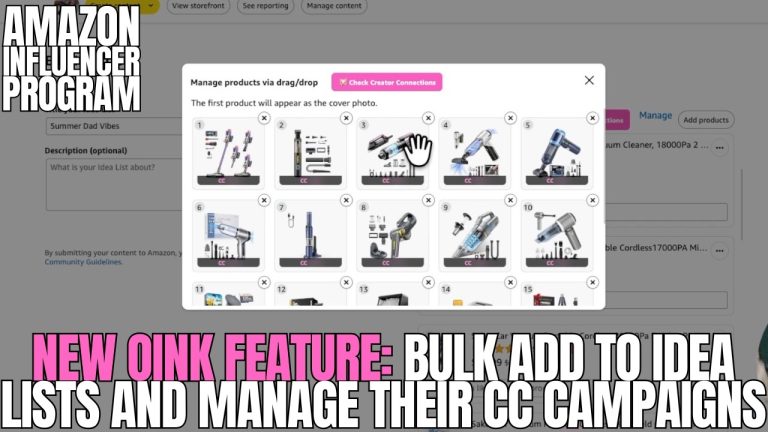
This is also where tooling matters most. On-site, you’re not competing for an audience, you’re competing for carousel slots on products that are actually selling. That’s the entire reason Oink exists. Storefront Cross Check, Unavailable Video Matching, and the 5 Pillars system are all about picking products where your video can actually win a slot and convert. The faster-money lane is only fast if you’re pointing your videos at the right products.
Creator Rewards: The Bonus Most Influencers Never See
There’s another layer to the off-site advantage that most on-site creators don’t even know about. Amazon rewards off-site creators with something called Creator Rewards. These are incentive offers that basically say: if you generate X amount of revenue this month or next, we’ll pay you extra for hitting that target.
I’ve seen the Creator Rewards offers that go to some of the really big Facebook groups, and the incentive on a single month’s earnings would blow your mind. The on-site influencer side does occasionally get incentive offers too, but not very often, and when they do show up they’re nowhere near as lucrative as what off-site creators get. Once again, Amazon is signaling where it wants your effort to go.
How You Get Into Each Program
Both programs run off your existing Amazon account, and you can Google either one and sign up. The affiliate program is basically open enrollment. You fill out the form, they put you in, and then you need to make around three qualifying sales in your first 180 days to stay in. That’s it.
The influencer side is a two-step process and it’s harder. First you fill out the same kind of application, and you have to attach a social media account because the program is built around creators who have one. Then you submit three product review videos to Amazon. They review those three videos alongside your social account and decide whether they’re going to pay you to be an Amazon influencer. Plenty of people get rejected on that second step, which is why I spend so much time on video quality in my storefront audits.
Why Every Influencer Needs to Become an Affiliate Too
Here’s the part I really want to land. Even if you’re “just” an Amazon influencer today, you need to be working on becoming an Amazon affiliate as well. At the end of the day, this is what Amazon wants, and a lot of the recent changes to the program show it. Start a Facebook group. Start an Instagram account. Start a YouTube channel. Build something where you can create links and drive traffic over to Amazon.
Not only is there better overall money if you can pull it off, but every signal I’m seeing says Amazon’s focus is shifting even harder toward creators who bring their own traffic. If all you’re doing is the influencer program, you’re taking advantage of traffic that’s already on Amazon, and that’s the behavior they reward least. On-site is your fast start. Off-site is your long game. The creators who are going to be making real money in two years are the ones doing both.
Here’s the full video if you’d rather hear me walk through it:
Whichever lane you’re in right now, the on-site side only pays when your videos land on products that actually sell and actually have room for you. That’s what I built Oink to do: find those products before you spend an hour filming. Grab the extension at oinkforinfluencers.com and start putting your next video on a product that can pay you back.