If you’re reposting your Amazon storefront videos over to YouTube, there’s one thing you’re almost certainly missing — and without it, those videos are basically decorative. You’ll get views. You’ll watch the view counter tick up and feel good about it. And you will make close to nothing, because the people watching have no idea you have a link at all.
What We’re Covering
- YouTube Is a Search Engine, Not a Highlight Reel
- The Missing Piece: A Call to Action
- Why Your Amazon Video Can’t Have One
- How Oink Fixes It
- Setting It Up in the Content Cross-Posting Center
- Closing the Gap Between Watching and Clicking
YouTube Is a Search Engine, Not a Highlight Reel
The thing you have to remember about YouTube is that it’s a search engine. It’s owned by Google, and Google is obviously very good at search engine stuff.
So when someone watches your reposted Amazon influencer video, it’s not an accident. They typed something into the search bar, YouTube served them a set of options, and they picked yours. That’s fantastic — you just got a viewer with genuine buying intent who chose you.
Then they watch. They get exactly what they wanted out of it. And then they leave without clicking anything, because nobody ever told them there was something to click.
The Missing Piece: A Call to Action
There’s a reason nearly every successful YouTube video says some version of “there’s a link down in the description below, go click it.” It sounds repetitive to us because we’ve heard it a thousand times. It works because most viewers genuinely do not think about the description unless you point at it.
Your reposted Amazon video has no call to action. No on-screen text pointing down. No verbal nudge. Nothing. The viewer had no idea a link existed, and plenty of them would have clicked it if they’d known.
Why Your Amazon Video Can’t Have One
Here’s the trap, and it isn’t your fault. Amazon doesn’t allow calls to action in your influencer videos. You can’t say “link in the description” in a video that lives on an Amazon product page — that’s not what those videos are for.
So what happens is you take a video that structurally cannot have a call to action, and you move it onto a platform where calls to action are one of the most important things there is. The format that made it compliant on Amazon is the exact thing that makes it fail on YouTube.
Most people never notice, because the views still come in. Views feel like progress. They aren’t, if nobody ever reaches your link.
How Oink Fixes It
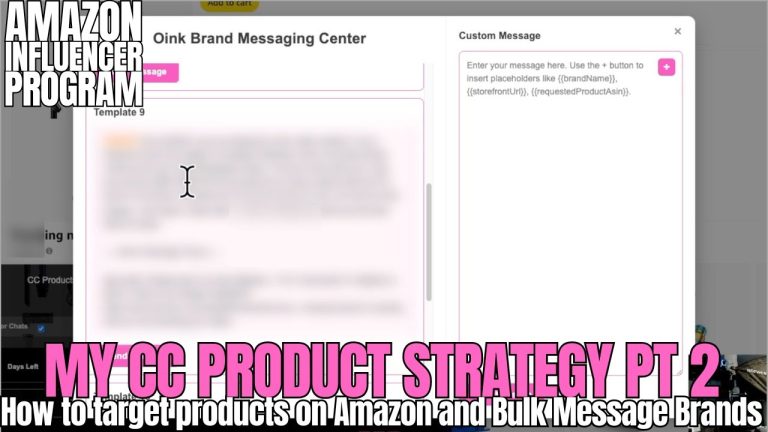
This is exactly the problem I built the update I released last week to solve. Oink now handles the whole cross-post for you, and the call to action is the centerpiece.
On a video I reposted from my own storefront, it now carries a burned-in call to action — “link in the description” — plus a “subscribe for more reviews.” That text is part of the video itself, so viewers see it whether or not they’re paying attention to anything below the player.
And while it’s doing that, it also handles the rest of the busywork:
- Pulls your thumbnail over from your storefront, so the custom thumbnail you already made doesn’t go to waste.
- Writes an SEO-driven title with AI — and if the video is a comparison, it writes a comparison-style title.
- Writes the description to match, automatically.
- Inserts your affiliate link where you tell it to go.
All of that is handled without you touching it.
Setting It Up in the Content Cross-Posting Center
The new Content Cross-Posting Center shows all the videos you’ve made, with a YouTube badge on the ones you’ve already uploaded. Here’s the flow:
- Find the video you want to post and click the edit icon. That opens the edit screen for a video you’ve already completed.
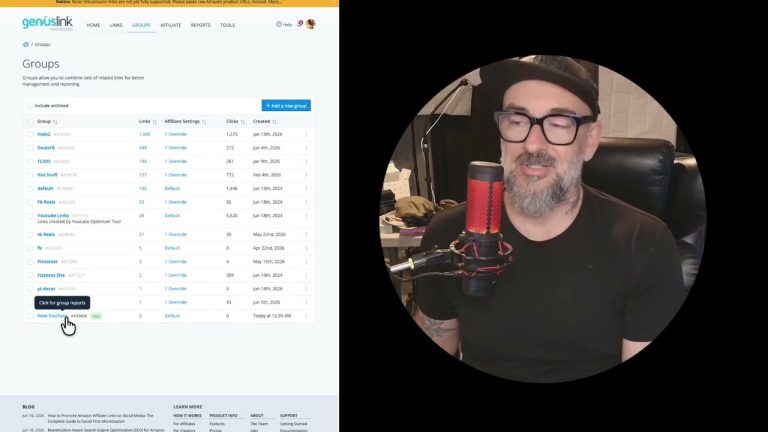
- In the new section at the bottom, pick your Genius Links group. Choose your default group and Oink automatically inserts your Genius Link.
- Pick the channel you want to post to. The update supports multiple channels, so if you run more than one YouTube channel you can choose which one gets it.
- Click the YouTube button.
Then watch what it does. A window pops up: downloading your video from Amazon. Then — and this is the part I’m proud of — burning your call to action text onto the video.
You have control over all of it. Write your own call to action. Write your own disclosure. Tell Oink where to place your affiliate link. Add extra instructions for the AI title and description if you want a particular angle, though honestly it already does a good job on its own. It pulls in every channel under your account, so you can post different videos to different places, and you pick where the call to action sits on screen.
Closing the Gap Between Watching and Clicking
One of the real keys to getting people to actually click your links on YouTube is minimizing the gap between watching your video and finding your link. Every second of confusion in that gap is a lost commission.
If you’re not putting a call to action on your video, you are asking an enormous amount from the person watching. You’re asking them to independently decide, unprompted, that you probably have a link somewhere, then go looking for it. Some people will. Most won’t. And a channel built on that assumption is going to be very hard to scale and very hard to monetize.
Cross-posting to YouTube is genuinely one of the best free traffic plays available to Amazon influencers right now — you’re taking content you already made and putting it in front of people actively searching for that exact product. Just don’t do it without a call to action. That one missing piece is the difference between a view counter that looks nice and a channel that actually pays you.
The Content Cross-Posting Center is live now inside Oink. If you’re already reposting to YouTube, go add your call to action before you upload another video.