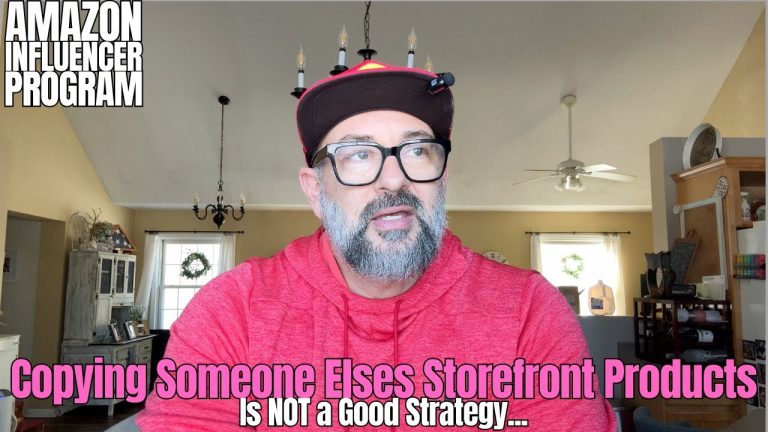
I have been making five figures a month in the Amazon Influencer Program since the end of 2024, and there is one question I get more than almost any other: should I go back through my old videos and fix them? Add parent ASINs, swap the thumbnails, rewrite the titles, clean up the tags?
Almost always, the answer is no. Don’t play touchy touchy. And the reason has nothing to do with laziness — it has to do with how Amazon actually handles a video once you touch it.
In This Article
- My Beef With Parent ASINs
- The Real Reason: Your Video Goes Back Through the Hopper
- What Actually Counts as an Edit
- Reason 1: The Product Is Dead and the Video Is Broken
- Reason 2: A Low Performer on a Strong-Selling Product
- The Trap of Managing Work You Already Finished
- Big Earners Stay Forward-Facing
My Beef With Parent ASINs
Let me start here, because I am partly responsible for this one. I am the guy who introduced parent ASINs to this community. And I have watched that idea turn into a backlog obsession that I never intended.
The concept itself is fine. But somewhere along the way it became a reason for people to spend an entire weekend going video by video through two years of content, re-tagging everything, chasing a marginal improvement on videos that were already sitting there doing their job. That is not what it was for.
The upside on a change like that is small. The downside, as you are about to see, is not small at all.
The Real Reason: Your Video Goes Back Through the Hopper
Here is the part almost nobody accounts for.
When you edit a live video, it goes back through Amazon’s review process. It re-enters the hopper. And Amazon’s review is not a human sitting there remembering that this video already passed eight months ago — it is an automated system evaluating it fresh, against whatever the current standards happen to be.
Which means a video that passed just fine the first time can absolutely come back rejected the second time. The standards move. The AI is not the same AI it was last year. Something that was acceptable in your video then may not clear the bar now.
So think about what you just did. You had a live video earning commissions. You made a small cosmetic change that was probably never going to move the needle. And now you have a rejected video, no commissions from it, and a problem you have to go solve. You converted an asset into a chore.
What Actually Counts as an Edit
People assume this only applies to re-uploading footage. It does not. The changes that put your video back in line include:
- Editing your tags or keywords
- Rewriting the title
- Swapping the thumbnail
- Adding or changing ASINs attached to the video
All of those are edits. All of them can send a working video back for another look. So when you are sitting there thinking “it’s just a thumbnail,” understand that you are gambling a live, earning video on a change you are guessing about.
Reason 1: The Product Is Dead and the Video Is Broken
There are exactly two situations where I think going back is worth your time. This is the first one.
If the product is gone — delisted, permanently out of stock, the listing died — then your video is not an earning asset anymore. It is a broken link. There is no downside to touching it because there is nothing left to lose. Re-pointing that video at a live, comparable product is one of the highest-return things you can do with old content, because you are taking something worth zero and making it worth something again.
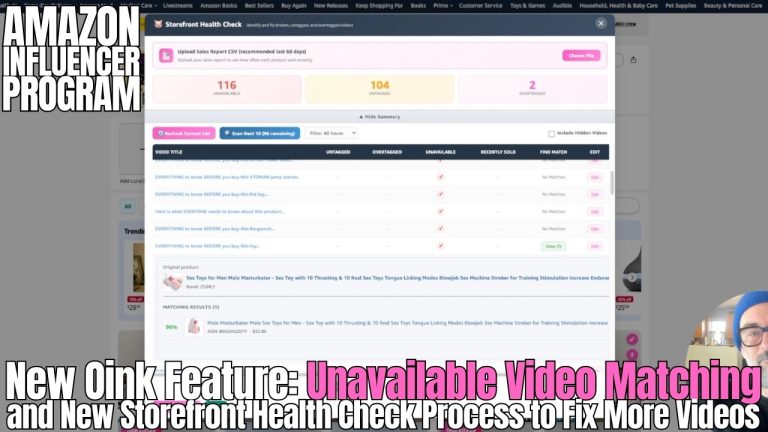
The hard part has always been finding them. Nobody is manually checking two hundred old videos to see which listings went dark. This is one of the things I built into Oink — it surfaces your broken videos automatically, so instead of auditing your backlog you just get handed the short list that actually needs attention.
Reason 2: A Low Performer on a Strong-Selling Product
The second case is more subtle. You have a video on a product that is genuinely selling well, and your video is barely earning. That gap usually means one thing: you are not getting placement in the carousel.
In that specific situation, resubmitting can be worth it, because you are effectively forcing Amazon to reconsider where your video sits. The product demand is already proven. You are not hoping the product takes off — it already has. You are just trying to get in front of it.
Notice how narrow that is, though. It is not “this video underperformed.” It is “this video underperformed on a product that is demonstrably selling.” That distinction is the whole thing. Oink flags these too — low performing videos sitting on strong-selling products — because that intersection is where the actual opportunity lives, and it is nearly impossible to spot by eyeballing your dashboard.
The Trap of Managing Work You Already Finished
Outside those two cases, what backlog tinkering really is, is a very comfortable way to avoid making new videos.
I get it. Optimizing feels productive. You are in your account, you are clicking things, there is a checklist, you can see progress. Shooting a new video means setting up, being on camera, and putting something out that might flop. One of those is much easier than the other.
But you have to be honest about the math. Rewriting a title on a video from last March has a tiny ceiling. A new video on a product with real demand has an open one. Every hour you spend managing work you already finished is an hour not spent creating the thing that actually compounds.
Big Earners Stay Forward-Facing
Look at the creators earning the most in this program. They are almost never looking backwards. Their old videos sit there and do whatever they do, and their attention is on the next batch. They fix things that are genuinely broken, and they ignore everything else.
That is not because they are more disciplined than you. It is because they figured out early that the backlog is a finite pile with a low ceiling, and the future is not.
So here is the takeaway: leave your old videos alone unless they are broken or they are underperforming on a product that is clearly selling. If you want those two lists handed to you instead of hunting for them, that is exactly what Oink does — it finds your broken videos and your low performers automatically, and points you at the products worth shooting next. Go take a look, then go make something new.