A couple of days ago I woke up, opened Facebook, and walked straight into pure panic. People had gone to their earnings page and noticed something was missing — the Creator Connections tab, arguably the most important part of the whole program, was reporting completely differently. And I get the panic. When the thing that pays you suddenly looks different, your stomach drops. But I want to be honest with you about my own reaction: I had about 1% concern. I did not even really look into it at first. Here is what actually changed, why I was not worried, and the one part of this that I think you should actually pay attention to.
In This Article
- Why I Wasn’t Worried in the First Place
- What Actually Changed in Creator Connections Reporting
- Why Your Report Is Full of Blank Lines
- This Is a Double Down, Not a Test
- The Strategic Impact Is Basically Zero
- The Trust Question Nobody Wants to Ask Out Loud
- What This Changes Inside Oink
- Why Amazon Is Really Doing This
- What I’d Actually Do Differently Now
Why I Wasn’t Worried in the First Place
The reaction I saw in the groups was some version of “are they taking this away from us?” And when you have been in these programs for a while, there is something I think is fundamentally true that lets you skip most of that anxiety.
If Amazon is going to make a major change to how you earn, they tell you ahead of time.
That is not something that just randomly shows up one Tuesday morning while you are drinking coffee. Earnings changes get announced. We saw exactly that starting at the end of last year and running through all the changes that rolled out in March and April. Amazon gave notice every time.
So when something appears with no warning, the odds are overwhelming that it is a reporting or interface change, not a change to how the money works. That is a useful filter to keep in your head permanently. It will save you a lot of stress in this business.
Worth noting: Amazon did not announce anything until the first day of the rollout, and my guess is they only put something out mid-day because people started writing in panicking. The notice said they were rolling out starting that day through the next, and it sounded reporting-related. That is where I placed my bet. I turned out to be half right and half wrong.
What Actually Changed in Creator Connections Reporting
Here is what I predicted, and here is what actually happened.
There is a long-running quirk in this program: Creator Connections has its own earnings reporting system, separate from the regular side. If you go into Creator Connections and click “see more,” you can look at something like the last 30 days of earnings — but that number never quite matches the earnings page on the regular side. Not by much. Just a little bit off, consistently, for whatever reason.
So my assumption was that Amazon was finally creating consistency between the two so the numbers would line up. I was right about consistency. I was wrong about what they were making consistent.
What they actually did was make Creator Connections reporting look identical to the regular Amazon side reporting. And remember what happened to the regular side in March and April: they rolled out visibility thresholds. If a product sells fewer than four units, it does not appear on your report anymore.
That is exactly what has now landed on Creator Connections. They created congruency between the two systems — by bringing Creator Connections down to match the more limited visibility of the regular side.
Why Your Report Is Full of Blank Lines
This is the specific thing confusing the most people, so let me spell out the mechanics.
For Creator Connections, when you select a time frame like the last 30 days, a product shows up on your report if either of these is true:
- It sold at least 4 units in that window, or
- It got at least 10 clicks in that window
So those blank lines you are staring at? Those are products that did clear the 10-click threshold — that is why the row exists at all — but did not hit 4 units sold, so the sales number is suppressed.
Read that again, because it is actually good news wearing a bad disguise. You very likely made sales on those blank rows. If something got 10-plus clicks, there is a high likelihood it converted at least once or twice. The report is just not showing you the number. You are still getting the credit and you are still getting paid. You just cannot see it.
This Is a Double Down, Not a Test
This is the part I actually want you to internalize, because it tells you something about the future.
When the original threshold system rolled out in March and April, people were genuinely angry. Creators wrote in. They filed tickets. There was a real belief that if enough of us complained, Amazon would reverse it. At the time I said: look, they have already rolled this out in Australia, this is a global change, I do not think they are reversing it.
And Amazon absolutely knew people hated it. I was talking to the one Amazon rep I know personally, and she told me plainly that they knew, that they were getting slammed with complaints during that stretch — but there was never any indication Amazon intended to change course.
Now they have taken that same system and expanded it into Creator Connections. They took the base, acknowledged people did not like it, and made it bigger.
To me that is a massive signal: this is the reporting system going forward. There is no amount of complaining that reverses it, at least not any time soon. They are expanding it despite knowing you do not like it. Plan around that reality instead of waiting for it to be undone.
The Strategic Impact Is Basically Zero
I said this a couple of months ago when the original reporting change rolled out, and I will say it again now: strategically, I do not see any real impact here.
The program has not changed in how you earn. Commission structure, attribution, campaigns, payouts — all identical. What changed is what you can see.
Ask yourself honestly: were you building strategy off a product that sold once or twice? You probably were not. Nobody restructures their content calendar around a single unit. You start paying attention when something sells more — and everything at that volume is still fully visible to you.
Where I think the real loss is: motivation. Seeing those individual ones and twos was genuinely great, especially when you are new and you need proof the thing is working. You were always getting the credit and the earnings, but it was nice to see it. I wanted to see the ones and the twos too. Losing that is a real cost — it is just an emotional cost, not a strategic one.
The honest adjustment for me is behavioral. I am used to looking at that report. I am not going to look at it anymore. That is a change to my routine, not to my business.
The Trust Question Nobody Wants to Ask Out Loud
The pushback I keep getting is: “How am I supposed to know I’m getting what I earned if I can’t see it?”
I want to give you a straight answer rather than a comfortable one. That gray area has always existed in this program. There have always been moments where someone looks at a report and says “I sold this, why am I not getting credit for it?” That is not new — the threshold just made it more visible as a feeling.
Talk to people who have been doing this a long time and they will tell you they pay hardly any attention to that stuff, because Amazon generally gets it right even when the interface looks weird. I have been doing this three years. Do they get a thing wrong here and there? Occasionally. Is their attribution system generally correct? Yes.
So I understand that losing visible individual sales creates an emotional disconnect — a “how do I trust this now” feeling. I just do not think the underlying trust equation actually changed. Your verification was always partial. It is now slightly more partial.
What This Changes Inside Oink
I want to be transparent with Oink users, because a couple of features pull from these reports.
A few weeks ago I rolled out the CC trend system that surfaces your top trending Creator Connections products. That feature was built on the full report we had access to at the time. You do not really have a full report anymore, so if you are not selling a lot of volume, you may see thin results or nothing at all in that section.
I ran it on my own account yesterday to see how bad it was. It populated — I have a lot of videos and I have been at this a while — but one of the sections only returned a single product because the underlying data simply is not there anymore.
That said, nothing fundamental about how you use Oink changes. Storefront Cross Check, Unavailable Video Matching, the Comparison Video Schedule, and the 5 Pillars product research system all run on data sources that were not touched by this. The trend reporting was a nice-to-have for seeing what was working and what was not. It was never the engine.
Why Amazon Is Really Doing This
You and I are not the demographic Amazon optimizes for when it comes to making money. That is not bitterness, it is just math.
These changes started rolling out around the middle to end of last year, and it was obvious from the start they were built for large publishers. When I say large publishers I mean the New York Times, TechCrunch, CNET — outlets posting affiliate links and moving thousands of units a month. They do not care about ones, twos, and threes. That granularity does them zero good, and it clutters their reports. Amazon makes enormous money from those partners, so Amazon built systems that cater to them.
There is also a straightforward infrastructure argument. Serving line-item reports for single-unit sales across Amazon’s entire creator ecosystem is a genuinely large amount of server memory for very little value on their end.
And from Amazon’s side, they cannot have different sets of reporting behaving differently in different parts of their own ecosystem. They implemented the threshold a couple of months ago and are now bringing everything else in line with it. From that standpoint, I get it. It is the right engineering decision.
What I would push back on is the one-size-fits-all part. The right move would have been segmentation — if you are above a certain earnings or volume threshold, you only see 4-plus unit sales, because that is what you want anyway. For creators at our scale, who are not moving thousands of units a day, let us see the smaller stuff. That would have served everyone. But it is what it is.
What I’d Actually Do Differently Now
Practical takeaways, since I do not want to leave you with just analysis:
- Stop treating the CC report as a daily dashboard. It is not built for that anymore. Check it periodically for products clearing the thresholds and stop refreshing it for dopamine.
- Use clicks as your early signal. With sales suppressed under 4 units, the 10-click threshold is now your leading indicator. A product showing clicks with a blank sales column is a product with traction — treat it as a candidate for more content, not as a failure.
- Lengthen your evaluation windows. A 7-day view will look emptier than it used to. Pull 30 days or more so products have a chance to clear the thresholds before you judge them.
- Judge performance on total earnings, not line items. Your payout number is complete and unaffected. That is your source of truth now.
- Do not wait for a reversal. This is the system. Building your workflow around the assumption it gets rolled back is going to waste your time.
I talk to people doing this at a high level — $5,000 a month, $10,000, $20,000, $30,000, $70,000 a month. I’m looking at you, Scott. Not one of us is concerned about this change. It is annoying. It genuinely feels like getting the cold shoulder because we are not the New York Times. But it does not change our strategy or our ability to keep earning, and it does not change yours either.
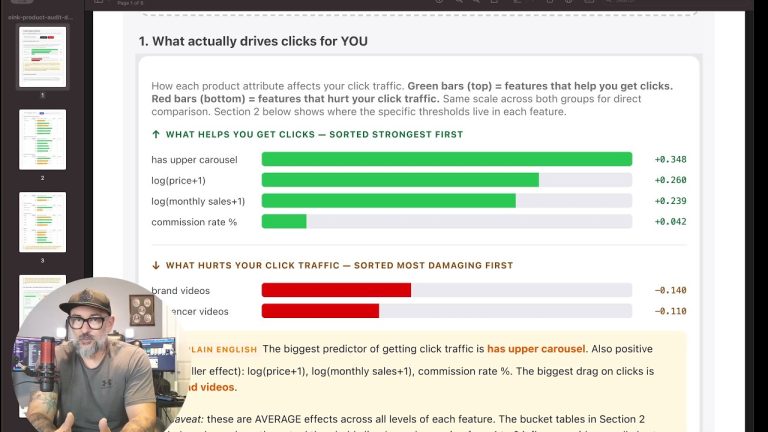
Every time Amazon narrows what you can see, the creators who win are the ones who were never relying on that visibility to begin with — the ones doing real product research before they ever pick up a camera. That is exactly what I built Oink to do. Storefront Cross Check shows you what competing storefronts have that you don’t, Unavailable Video Matching finds the videos quietly costing you money, the Comparison Video Schedule tells you which head-to-head videos to shoot next, and the 5 Pillars system points you at products where a top carousel slot is still winnable. If Amazon is going to show you less, you need better data going in. Come take a look at oinkforinfluencers.com.