I run storefront audits for Amazon influencers, and I’ve done enough of them now that the same handful of problems keep showing up. In the most recent one I pulled the last 50 videos off a creator’s storefront, ran them through my analysis tool, and found something that I think a lot of you are going to recognize in your own work: great product selection, and videos that were never going to convert anyway.
Here’s the full teardown, and what you should take from it.
Table of Contents
- What a Storefront Audit Actually Looks At
- Price Per Product Is the Wrong Obsession
- Units Sold Per Month Is the Number to Watch
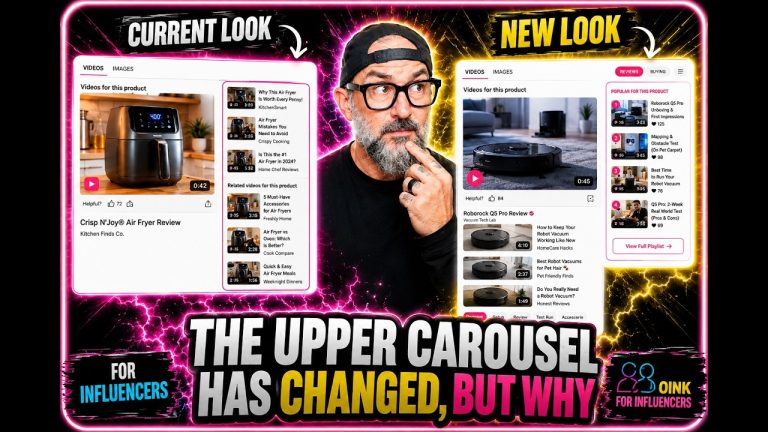
- Upper Carousels and Visibility
- The Video Length Problem
- The Faceless Video Risk
- The Biggest Issue: No Demonstration
- TikTok-Style Videos Don’t Work on Amazon
- Your Hook Is About Them, Not You
- Thumbnails and Titles
- The Takeaways
What a Storefront Audit Actually Looks At
I built a tool that pulls the last 50 videos from a storefront and breaks down the types of products being selected across the metrics that actually matter. Products can make or break your video. Whether a product is something that can genuinely make you money determines how well your videos perform, no matter how good the video itself is.
On this particular storefront, the top-line numbers were strong. Out of the last 50 videos, 88% were on products that are selling, and 86% were on Creator Connections. Right off the rip, those are really good numbers — probably some of the highest I’ve seen in conjunction with each other in a while.
That tells me this creator is being specific. Logical and strategic about product picks. Not just grabbing whatever’s available — actually targeting.
Price Per Product Is the Wrong Obsession
The average selling price here was $22, which is one of the lowest I’ve seen. And I gave no call to action on it.
There are people out there who will tell you that to make money in this program you need to do videos on high-priced products. I’m just not buying that. My first month in this program I made over $2,000, and one of the main reasons was that I sold a bunch of a product that cost about ten bucks. An outdoor electrical cover. I sold a ton of them.
You can make a video on a product that costs a thousand dollars or a million dollars, and if it never sells you never make any money. Product opportunity will always have more value than product price.
Worth keeping in your back pocket, sure. Not worth restructuring your strategy around.
Units Sold Per Month Is the Number to Watch
Here’s where it got interesting. When a product on this storefront is selling, it’s only moving an average of 151 units per month. The target on my sheet says 2,354, and predominantly I see this number land between 2,500 and 3,500.
When I see something that low — even though we’ve established the products are selling — it tells me the creator is working heavily in the 50-to-100-units range.
Normally I don’t mind those at all. Some of the products I make the best money on only sell 200, 300, 400 units a month. I have no beef with that. But I’ve also got products selling a thousand, five thousand, ten thousand units a month. When your average starts creeping toward triple digits, it means you’re leaning too hard on products that sell, but barely.
Takeaway: set yourself a floor. Something like “I’m not doing this if it’s only moving 50 units a month.” Just moving away from the 50s will pull that number up.
Upper Carousels and Visibility
Out of the last 50 videos, 68% had upper carousels. The target is 84%.
I don’t hate 68%, but I don’t love it. Because so many of these products are on Creator Connections, this creator doesn’t need as much raw visibility as they would without them. Still, upper carousel placement is simply better visibility and a better chance of converting.
When there is an upper carousel, the average is 4.64 influencers in it, which caps at five. I don’t mind that at all — and with this much Creator Connections activity, I’m not going to hand out takeaways about competitor video counts.
The Video Length Problem
Now here’s the biggest problem on the sheet.
There have been several data analyses in this space — one that started with Data Coach Claire last year, another by a creator known as MC, and a big one I just wrapped up myself. All three of us found the same evidence: videos perform best in the carousels when they’re at least two minutes long.
It’s really hard to make a good in-depth video on a product in under a minute. Remember why customers are watching. They have questions about that product and they want to see it demonstrated. To do that properly — to actually think those questions through and answer them — under sixty seconds is nearly impossible.
My own minimum is about a minute and a half, and that’s if I run out of things to say. Most of mine land around two and a half minutes, because I’m trying to be thorough.
The people making the most money in this program right now are making in-depth videos, sometimes four, five, six, seven minutes long. And it’s not the length itself that’s winning. It’s that they’re longer because there’s more information in them. Length is a symptom of depth, not a substitute for it.
The Faceless Video Risk
A lot of these videos were faceless, and I want to be careful here because I know this is a sensitive one for people.
I’m not a big fan of faceless for two reasons. First, they’re the easiest videos to steal. If a thief wants to flood the Amazon influencer program with AI-generated content, faceless videos are the obvious target — and good-quality faceless videos are prime for the taking. Faceless is going to get cooked by AI.
Second, it’s called the Amazon influencer program. People want to connect with other people. Is showing your face required? No. Can you still win without it? Yes. I just don’t think you can win as much.
If something is stopping you — discomfort, nerves, whatever it is — I completely get that. But I’d like to see you get over that hump. At minimum, be in the video for the opening, then go to voiceover for the rest.
The Biggest Issue: No Demonstration
Here’s my number one beef with how these videos were made: there’s very little demonstration of the product.
An Apple CarPlay unit — no demonstration. Just talking about it, holding it. A face mask — being described in the package, never worn. A derma roller — talked about, never rolled. And this was a pattern up and down the storefront. Occasionally something would get demonstrated, but overwhelmingly it was products being shown rather than products being used.
I’m not saying this to be mean. I’m saying it because this is the thing that causes videos to convert, and skipping it misses the entire point of the program.
The buyer already read the listing. They already saw the specs and the photos. They already saw everything you just said out loud. If you’re not adding insight beyond that, why would they buy from your video?
What they want to know about that derma roller is: what is it like to use? Does it hurt? Does it actually make a difference? Does it change results? Those are the questions in their head, and they are the sole reason they clicked your video.
So: if it’s clothes, wear it. If it’s a derma roller, start rolling. If it’s a face mask, put the face mask on. If you don’t, you’re making videos that will never perform, you won’t make money, and you’ll burn out thinking the program doesn’t work — when really you just missed the point of it.
TikTok-Style Videos Don’t Work on Amazon
Almost every video here was vertical, which makes me think these might be getting posted to TikTok Shop first and then repurposed to Amazon.
I don’t inherently mind that. But you have to understand what you’re doing: even if you never touch TikTok, TikTok-style videos don’t perform on Amazon. It’s a completely different buyer base.
On TikTok, they want to be entertained. On Amazon, they need to be informed. Those two worlds do not match up.
If you’re cross-posting and your attitude is “if I make some money on Amazon, great, and if not, no big deal” — that’s completely fine. But if you’re actually trying to earn commissions over here, these are not the videos that will do it.
Your Hook Is About Them, Not You
One video opened with “these popsicle bags were such a great find.” That’s a pleasantry. It’s about the creator’s experience, not the buyer’s question.
Try this instead: “Do these popsicle bags actually work, or are they going to end up leaking all over the place?”
That’s what somebody shopping for popsicle bags is actually wondering. Open with that. Connect with the buyer immediately. Let them know they picked the right video — yours is the one that answers their question.
When you spend the opening talking about yourself, you’re spending your most valuable seconds on the thing the viewer cares least about.
Thumbnails and Titles
These are the two things that determine whether anyone watches your video at all.
The thumbnails here were good. Product front and center, clearly highlighted, doing exactly what a thumbnail should do. Whether that was intentional or not, keep it up.
The titles were the weak point. They were regurgitating what’s already on the listing page — and the buyer already saw the listing page. “Brightening serum” tells them nothing they don’t know.
Use your title to create curiosity. Give them a reason to click:
- “Does this serum actually work? I’m going to show you.”
- “Is this card actually worth it? I’m going to show you.”
- “Does this vacuum cleaner actually clean? I’m going to show you.”
Same product. Completely different click rate.
The Takeaways
If you want to audit yourself against this storefront, here’s the checklist:
- Set a floor on monthly units sold. Stop taking products moving 50 units a month.
- Stop optimizing for product price. Opportunity beats price every time.
- Push toward products with upper carousel placement.
- Get your videos past two minutes — by adding real information, not filler.
- Demonstrate the product in use. Not in the box. In use.
- Get your face in at least the opening of the video.
- Open with the buyer’s question, not your own commentary.
- Write titles that create curiosity instead of repeating the listing.
Most of the product-side metrics in this audit — units sold, carousel placement, Creator Connections status, competing influencer counts — are exactly the things Oink was built to surface before you pick a product, instead of after you’ve already made 50 videos. If you want to run these numbers on your own storefront, that’s where to start.