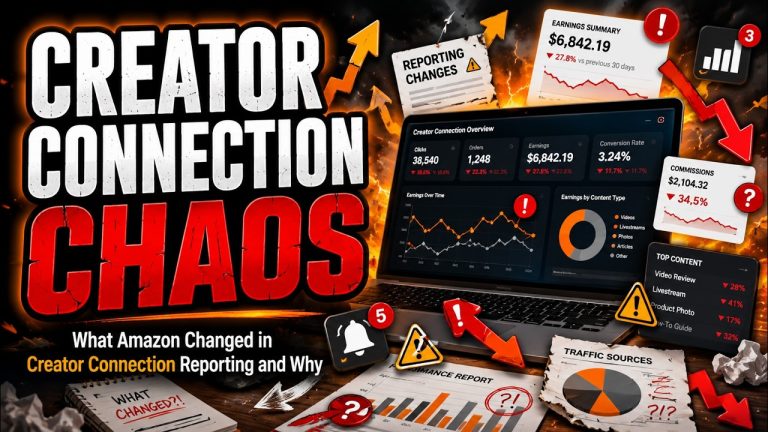
If your Amazon Influencer earnings have felt off for the last month or so, you’re not imagining it. I’ve talked with enough OGs in this program, people who’ve been around even longer than me, to know this isn’t just people being sensitive about their commissions. Several of them are telling me this is the worst drop they’ve seen in a couple of years. So I want to walk you through what I think is going on, and more importantly, the product research adjustment I believe every Amazon influencer needs to make right now.
Table of Contents
- Commissions Are Down, and It’s More Than Seasonality
- The September 16th Clue and a Possible Attribution Change
- Why the Reason Doesn’t Really Matter (Look to Q1)
- Why the Old Product Research Is Broken
- The New Question: How Many Valuable Videos Can I Make?
- Scale the Products You Already Have
- Your Action Plan This Week
Commissions Are Down, and It’s More Than Seasonality
Let’s be fair about the calendar first. There are a few things stacking up at the same time:
- Seasonality. Summer usually runs higher, then there’s a dip before the holidays pick things back up. We’re sitting right in that dip.
- Back-to-back Prime events. We had one in June and another in October. People get tired of that, and this year I saw way more online chatter about brands raising prices just to “discount” them.
- Black Friday announcements. When Amazon announces a big sale, shoppers hold off to see what’s going to be on it. Even my wife asked me what was going to be on sale.
All of that is real. But it’s normally not this heavy. I think something else is going on at a deeper level.
The September 16th Clue and a Possible Attribution Change
I’ve been digging through my own reporting, and I found something interesting. Comparing the month and a half before and after September 16th, a lot of my products had almost the exact same number of clicks, but conversions tanked. On roughly 25% of those products, I saw something like an 80% drop in conversions with the same click counts.
Then it hit me. Amazon sent an email saying they were changing the way clicks were counted, expanding it (likely tied to their sponsored products and off-site efforts), and that it wouldn’t affect earnings. That email went out on September 13th, three days before the change showed up in my numbers. Could be a coincidence. Could be the economy, high gas prices, and people simply buying less. But the timeline caught my eye.
The bigger thing my gut is telling me is that there’s been an attribution change somewhere. Attribution is simply how Amazon decides whether you get credit for a sale. We used to get credit for the direct product plus related products, and Amazon said back in April that related products were going away. I’m wondering if that change actually just kicked in now. I’m also hearing a lot of reports of Creator Connections earnings dropping hard, and if attribution changed on the Amazon side, it would ripple into Creator Connections too. I don’t have proof yet. I could be wrong. But I wanted to put it out there.
Why the Reason Doesn’t Really Matter (Look to Q1)
Here’s the thing: whatever the cause, it’s happening, and you can’t control it. We’re about to roll into the holiday season, and I expect we’ll get a reprieve with bumps in clicks and commissions for about a month and a half before things circle back around in mid-January.
If you’re filming videos right now, you’re really not making them for Q4 anymore. We’re halfway through it. You’re making them for Q1. So keep your head down and focus on what you can actually do, which brings us to product research.
Why the Old Product Research Is Broken
For the last year and a half, product research leaned heavily on two signals: Creator Connections and carousels. Both are unreliable right now.
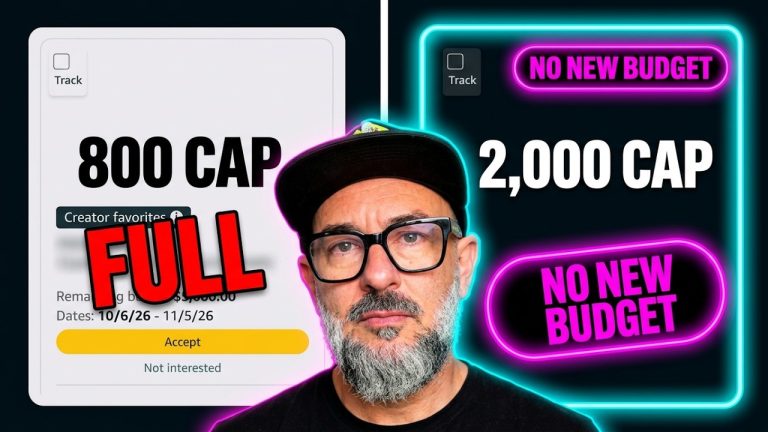
- Creator Connections campaigns are harder to get, so more creators are crowding into a smaller pool. Those products are way more oversaturated, and even if Amazon raises the cap, that just brings in more people and devalues the products further.
- Carousels don’t tell the same story anymore. You’ll see carousels with open slots where influencers simply didn’t get placed. We used to treat an open slot as an opportunity. That’s not reliable now.
On top of that, there’s a new kind of competition: volume. Cross-posting tools now make it easy for creators who’ve made 30 or 50 videos for a brand on TikTok Shop to push all of them onto that same product on Amazon. Whether Amazon treats that as duplicative content or not, it’s a lot of new volume flooding in, and that’s something we never had to compete with before.
The New Question: How Many Valuable Videos Can I Make?
Old product research asked, “Is this a good product?” Is it on Creator Connections? Is it selling? Does it have a carousel? If half of those signals aren’t trustworthy, we need a different question:
How many valuable pieces of content can I create for this product? That’s what determines if it’s good.
I used to say, “If it’s not selling, say no, because if Amazon can’t make money, you can’t make money.” I’m out of that now. I still prioritize selling products, but I’m no longer turning down products that aren’t selling, because a non-selling product can unlock more videos that feature selling products. Take a remote control that isn’t moving. Here’s how I’d approach it now:
- Anchor video: my in-depth review, around 2 to 2.5 minutes.
- Short video: a 30 to 45 second, TikTok-style clip answering the top two or three questions about the product with quicker edits.
- Comparison videos: do I have other remotes I can compare it against? If those are selling, this “non-selling” product just gave me a pathway to more videos with selling products in them.
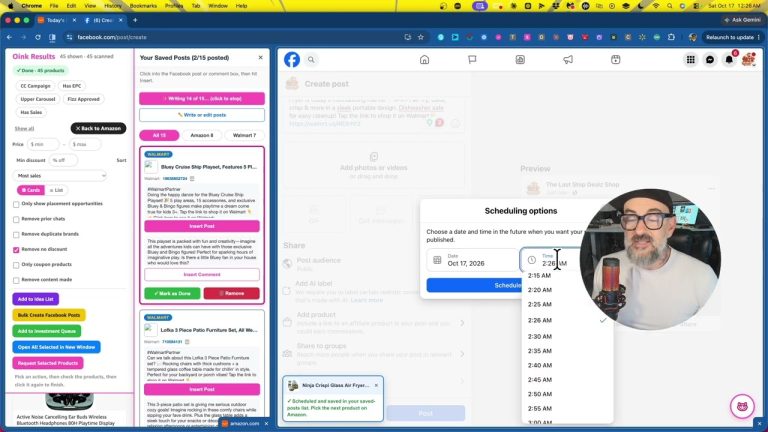
Everybody should be making at least two videos on every product that comes in. It’s not about whether one product is selling anymore. It’s about how many videos you can make that have selling products in them. Tools like Oink for Influencers help here by showing you what’s actually selling and where you’ve already got coverage, so you can spot those comparison and follow-up opportunities fast.
One important warning: I’m not talking about sitting down and shooting 15 unedited videos back to back to spam the carousels. Low-value slop is a good way to get kicked out of the program. Amazon allows multiple videos per product as long as they aren’t repetitive or duplicative and they add value for the customer.
Scale the Products You Already Have
We’ve been too isolated in how we view products. That short video I make for the remote? I’m going to put it on Facebook Reels with a link, probably post it around 10 times over the next month, maybe push it to Instagram and Pinterest too. If the system is scaling without us, we have to learn to scale the products we already have access to.
I also think a lot of us got addicted to Creator Connections and brand messaging, almost like a dopamine hit. We rush through the samples we already have so we can get back to the computer and message brands that, frankly, often don’t even want to talk to us. Break that habit. When I stopped relying on Creator Connections, carousels, and monthly sales numbers to tell me what a good product is, the gray area got a lot less gray, because now I’m in control.
Your Action Plan This Week
Go to your storefront and start working through the videos you’ve already got. For each one, ask yourself two questions:
- Do I still have this product?
- If yes, did I make at least two videos for it: a longer anchor video and a 30 to 45 second vertical short?
Spend more time doing that and less time chasing an oversaturated Creator Connections. Enjoy the holiday bump, and let’s build toward a stronger Q1. Watch the full breakdown here:
Remember, the question isn’t “Is this a good product?” It’s “How many valuable pieces of content can I make from this product?” If you want help finding selling products to pair with the ones you already own, check out Oink for Influencers. One price gets you every tool Oink has.