I said I was done with green box samples. Then two more showed up at my door today, and I said yes to both of them.
That probably sounds like I can’t stick to my own rules, but there’s a real reason behind it. My strategy for picking samples as an Amazon influencer has changed. I’m no longer asking “is this a good product?” I’m asking “how many valuable pieces of content can I make with it?” In this post I’ll walk you through both samples, why I took them, and how I squeeze more storefront commissions out of every product that comes in.
Table of Contents
- What the Green Box Battery Label Means for Your Samples
- Sample One: A Repeat Brand on Creator Connections
- My New Product Strategy: Content Value First
- Sample Two: A Health and Fitness Brand That Reached Out Directly
- Repurposing Content Across Your Storefront, YouTube, and Blog
- Ask Brands for More Than One Product
- Watch the Full Video
What the Green Box Battery Label Means for Your Samples
If you’ve been getting samples for a while, you’ve probably seen that green box label on certain packages. It’s the battery label, and it shows up on products that ship with batteries inside. Both of the samples I got in today had it.
I’ve talked before about being done with these. Battery products can come with extra handling and shipping considerations, and they aren’t always the easiest items to work with. So when I say I’m being picky about them, that’s why. But being picky doesn’t mean an automatic no. It means the product has to clear a higher bar, and both of these did.
Sample One: A Repeat Brand on Creator Connections
The first sample came from a brand that messaged me directly through Creator Connections. They had a brand-new product and a campaign I could grab, and I’ve already made content for about 10 of their products.
That history matters a lot. When you’ve built a relationship with a brand, saying yes keeps that relationship going. Repeat brands know your work, they come back to you first when they launch something new, and they’re more likely to keep sending products you can actually build content around.
So even though it was a green box item, this one was an easy yes. I’m not just evaluating one product here. I’m evaluating a brand that has already proven it’s worth my time.
My New Product Strategy: Content Value First
This is the biggest shift in how I work right now. I used to look at a sample and ask whether it was a good product. Now my first question is how many valuable videos I can get out of it.
A product that only gives me one mediocre video isn’t worth much, no matter how nice it is. A product that gives me several strong pieces of content I can place in multiple spots is worth a lot more, even if it’s not the flashiest item in the box.
Here’s the minimum I aim for with every product now:
- An anchor video. This is the main, in-depth video for the product that lives on my storefront and product page.
- A vertical short. A quick vertical cut I can use on short-form platforms and as an additional storefront video.
- At least two videos per product, period. If I can’t see two videos in it, I think hard before saying yes.
When you look at samples this way, you stop chasing products and start chasing content output. That’s what actually moves storefront commissions.
Sample Two: A Health and Fitness Brand That Reached Out Directly
The second sample came from a health and fitness brand that reached out to me directly rather than through a campaign. Fitness products are great for content because there’s so much you can show: setup, how it’s used, different exercises, and real-world results.
Again, it had the green box label. And again, I said yes, because I could already picture multiple videos coming out of it.
Repurposing Content Across Your Storefront, YouTube, and Blog
Here’s where the content-first approach really pays off. One product doesn’t have to mean one place to post. I repurpose what I make across:
- My Amazon storefront and product page videos
- YouTube, including a second channel
- My blog
Every extra place a video lives is another shot at a commission. If you’re only posting to your storefront and calling it done, you’re leaving money on the table. The same footage can work a lot harder for you.
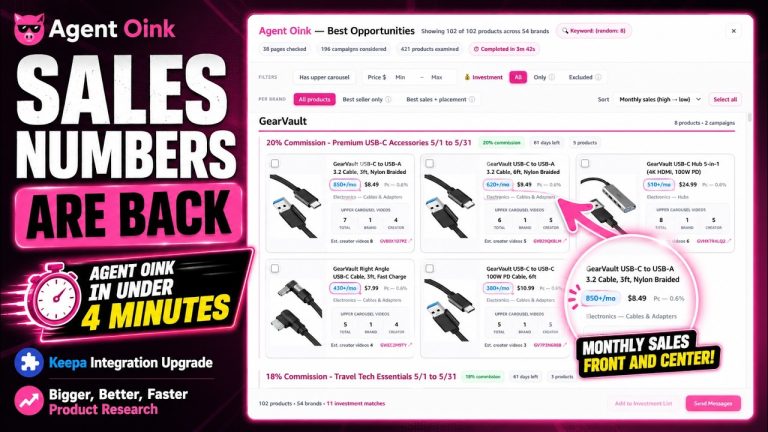
This is also why I use Oink for Influencers to find products worth making content for. When I know a product has real demand and good sales data behind it, I’m a lot more confident spending the time to make two, three, or more videos for it.
Ask Brands for More Than One Product
One more tip that has worked really well for me: ask brands if they’d be willing to send multiple products. A lot of creators never ask, but brands are often open to it, especially when you’ve shown you’ll make quality content.
I’ve had a brand send me six or seven pieces of equipment at once. That turns one relationship into a whole batch of content, and every one of those products can get its own anchor video and short.
If you’re working with a brand you already have a relationship with, this is the easiest ask you’ll ever make.
Watch the Full Video
Want to see both samples and hear me walk through my thinking? Watch the full video below.
If you want to spend less time guessing which samples and products are worth your effort, check out Oink for Influencers. It’s built to help Amazon influencers and affiliates find products worth making content for and make more commissions from every video. And let me know: how many videos do you make per product?