A week and a half into Amazon’s global storefront rollout, my inbox and the Oink community are full of the same message: “I picked my home country and my international earnings fell off a cliff.” So I did what I always do when Amazon ships something confusing. I sat down with Amazon’s own documentation and read it line by line. Here’s my read on what actually happened, why your dashboard looks broken, and what it means for how you run your Amazon Influencer business going forward.
In This Article
- This Is Not Really a Storefront Change
- How One-Link Localization Works
- What Happens to Your Tracking IDs
- Why Your Countries Look “Missing”
- On-Site Placement Got Swept Up in an Off-Site Change
- Should You Pick Your Home Country?
- What This Means for Cross-Posting Your Videos
- How to Protect Your Storefront Right Now
This Is Not Really a Storefront Change
Amazon called this the “global storefront.” Everyone, including me at first, assumed it was about the storefront: one page, visible in every country, with your videos following you around the world. After reading the documentation, I don’t think that’s the core of it at all. What Amazon actually built is a global earnings change, and the thing it’s built around is off-site affiliate links.
Read the language carefully. Almost every sentence is about links: one link that localizes to the shopper’s country, earnings consolidated under one account, tracking IDs merged. That’s affiliate infrastructure. The storefront piece, where your page gets auto-translated and local products get swapped in, is a side effect of the same system. The problem is that on-site product placement, which is where most of us actually earn, got pulled into a system that was designed for something else.
How One-Link Localization Works
Under the old system, if you wanted to earn in Canada, you needed a Canadian tracking ID and a Canadian link. Same for the UK, Germany, and so on. Under the new system, you share one link. When a shopper in Canada clicks it, Amazon routes them to the Canadian version of that product and credits the sale to your account. If the product doesn’t exist in that country, Amazon substitutes a local equivalent.
For an off-site affiliate running a blog or a deals group with international traffic, that’s a real improvement. You stop juggling five link formats. But notice what it assumes: that you are the one placing the link in front of the shopper. That’s an off-site model. It doesn’t describe how an influencer earns when Amazon places your video on a product page in the carousel.
What Happens to Your Tracking IDs
This is the part that’s making people panic. After you select a home country, your old country-specific tracking IDs start disappearing. The earnings that used to show up under your Canadian or UK ID don’t show up there anymore. People are looking at an empty row where last month’s commissions were and assuming the money is gone.
From what the documentation describes, those IDs are being merged into your home-country account rather than deleted. The reporting moves, it doesn’t vanish. But Amazon did a poor job of showing the transition, so your dashboard looks like a country just fell off the map. If you ran multiple countries, pull your earnings reports from before you selected a home country and save them, because the historical view is going to get muddy.
Why Your Countries Look “Missing”
Once you consolidate, the dashboard reorganizes around your home marketplace. International sales that used to be broken out by country now land in a consolidated “global earnings” bucket, and in some views they aren’t broken out at all. So the Canadian earnings you were watching every day aren’t labeled Canadian anymore. They’re just earnings.
That alone would be annoying but survivable. The bigger issue is that a lot of creators are reporting the total went down, not just the labeling. Which brings me to the part I think matters most.
On-Site Placement Got Swept Up in an Off-Site Change
Here’s my honest read. If you were cross-posting your Amazon Influencer videos to Canada, the UK, and Germany, you were earning on-site commissions in each of those marketplaces because your videos were placed in each country’s carousels. That was a separate storefront per country, with separate placement.
When Amazon merges everything into one global account built around link localization, the question becomes: does your video still get placed in the Canadian carousel, or does Amazon now treat Canada as a localization target for your US link? Based on what creators are seeing, it looks like on-site placement in secondary countries is being deprioritized, or at minimum isn’t carrying over cleanly. The earnings drop people are reporting lines up with carousel placement in those countries going away, not with links breaking.
I want to be clear that I only ran two countries myself, so this is an informed read, not a complete dataset. But the pattern is consistent across the people I’ve talked to.
Should You Pick Your Home Country?
If you haven’t selected yet, slow down. Amazon is going to make you choose eventually, but there’s no prize for being first. Before you do it, pull every international earnings report you have, screenshot your per-country dashboards, and make a list of which products were earning in which marketplace. You want a record of what your international business looked like before the merge, so you can tell whether earnings actually dropped or just moved.
If you only ever ran the US, this probably changes very little for you day to day. If 20 to 40 percent of your income was coming from Canada and the UK, treat this as a real business event and plan for a dip.
What This Means for Cross-Posting Your Videos
For a long time, cross-posting was one of the easiest wins in this program. One video, three or four marketplaces, three or four streams of commissions. If on-site placement in secondary countries is really being deprioritized, that multiplier shrinks. The video is still yours and it may still show on your translated storefront, but the carousel placement that drove the bulk of those sales is no longer guaranteed.
My advice is to stop building your content plan around international volume until the dust settles. Go back to the thing that always worked: finding products in your home marketplace that other influencers can’t easily get, and making videos that earn on-site where placement is still predictable. That’s the 5 Pillars system in Oink, and it’s exactly why I built it around product research rather than around geography.
How to Protect Your Storefront Right Now
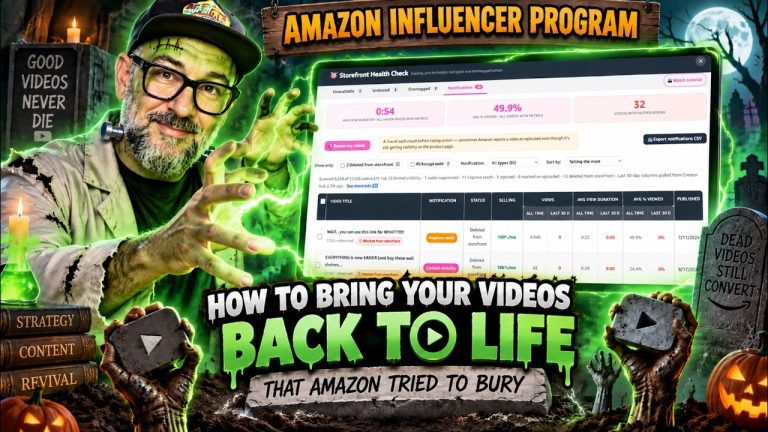
Three practical things. First, run Storefront Cross Check in Oink so you have a current snapshot of every video on your storefront and which products are attached. If Amazon swaps in local products on your translated storefronts, you want to know what your original mapping was. Second, run Unavailable Video Matching. Videos that were attached to products in a secondary marketplace can end up looking unavailable after the merge, and catching those is the difference between a video that earns and one that quietly dies. Third, keep making content on a schedule. The Comparison Video Schedule exists so you don’t stop producing while you’re busy reading Amazon documentation.
I’ll keep updating as I see more data from more accounts. Here’s the full breakdown if you want to follow along with the documentation.
If you want a tool that tracks your storefront, catches buried videos, and keeps you focused on products that actually earn no matter what Amazon changes next, try Oink at oinkforinfluencers.com.