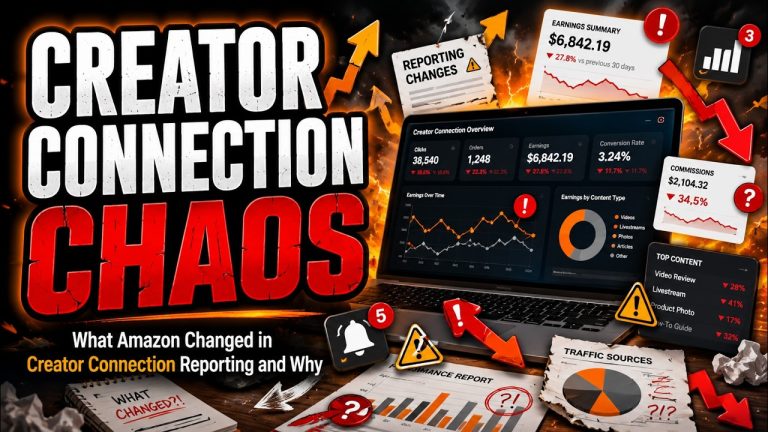
I got tired of guessing. Every Amazon influencer forum is full of confident opinions about what Amazon “wants” — film vertical, film horizontal, keep it under a minute, always use a custom thumbnail — and almost none of it is backed by anything. So I spent weeks pulling data on more than 11,000 products, 37,000 Amazon Influencer videos, and 13,000 creators to find out what the numbers actually say. Here’s everything I found.
Table of Contents
- What I Analyzed and Why
- Ranking vs Engagement: Two Different Games
- How Long Should Your Video Be?
- How Often to Mention the Product
- Horizontal vs Vertical
- What the Title Data Showed
- Why Comparison Videos Punch Above Their Weight
- Do Custom Thumbnails Actually Matter?
- The Playbook for Your Next Upload
What I Analyzed and Why
The dataset covers 11,000+ products, 37,000 Amazon Influencer videos, and 13,000 creators. I looked at video length, orientation, title structure, custom thumbnails, how often the product gets mentioned, and comparison videos — then measured those against carousel position and helpful votes.
I want to be upfront about why those two measures matter. Carousel position is where your video sits in the lineup on the product page. Helpful votes are what shoppers do after they watch. Almost every piece of advice floating around out there conflates the two, and that’s exactly where creators go wrong.
Ranking vs Engagement: Two Different Games
This is the single most important framing in the whole study, so I’ll say it plainly: ranking and engagement are two separate games, and most creators only play one of them.
A great slot in the carousel means nothing if nobody clicks your video. And clicks mean nothing if you never ranked in the first place. You need both, and the things that get you each one are not always the same things. Some choices help you rank but hurt your click-through. Some make people vote helpful but do nothing for your position.
So when you read the findings below, ask yourself which game each one is solving for. That’s how you decide what to change on your next upload instead of trying to optimize for everything at once.
How Long Should Your Video Be?
Shorter keeps winning. That was the clearest directional finding in the length data, and it held up across the set.
I know that’s frustrating if you’ve been putting real effort into thorough, detailed reviews. But think about the context. Someone is on a product page, mid-decision, deciding whether to buy. They are not settling in for a documentary. They want to see the thing, see it work, and get out. The videos that respect that are the ones that perform.
The practical takeaway: cut your intro. Almost every underperforming video I looked at spent its opening seconds on throat-clearing instead of showing the product.
How Often to Mention the Product
This one surprised people when I walked through it. How often you say the product’s name inside the video is not a neutral choice — it’s a variable that moves with performance.
There’s a balance to strike. Say it too little and there’s nothing tying your content to the listing. Say it constantly and you sound like an ad, which is exactly what shoppers are trying to avoid when they scroll down to creator videos in the first place. Natural, repeated mentions in the flow of actually demonstrating the product is the version that works.
Horizontal vs Vertical
The horizontal-versus-vertical argument has been going for years with basically zero evidence attached to it, so this was one of the findings I most wanted to settle.
The answer matters more than most creators think, because orientation is a decision you make before you press record. Get it wrong and you’re not fixing it in editing. If you’ve been defaulting to one format out of habit — most people have — this is worth watching the breakdown on, because the data does favor one side in the Amazon carousel context specifically. What performs on other platforms is not the question here.
What the Title Data Showed
Titles turned out to be the richest part of the study, probably because they’re the cheapest thing to change and almost nobody optimizes them. Four findings stood out.
- One ALL CAPS word boosts position. Not the whole title — one word. It catches the eye without reading as spam.
- Asking a question works as a curiosity hook. Question-format titles pull clicks because they mirror what the shopper is already wondering.
- Punctuation has an effect on ranking. It’s a smaller lever than the others, but it’s not nothing.
- The sweet spot is 50–69 characters. Long enough to be specific, short enough not to get cut off.
If you only change one thing after reading this, change your titles. It costs you nothing and you can go back and fix the ones already live.
Why Comparison Videos Punch Above Their Weight
Comparison videos rank well and convert well, and the reason is obvious once you say it out loud: a shopper looking at two similar products has a question that a single-product review structurally cannot answer.
They’re also efficient. One shoot, multiple products, multiple listings your video can appear on. The catch is planning them — you need to know which products are worth comparing and keep track of what you’ve already covered. That’s the exact reason I built the Comparison Video Schedule into Oink, alongside Storefront Cross Check and Unavailable Video Matching for keeping your existing storefront clean.
Do Custom Thumbnails Actually Matter?
Custom thumbnails are gospel in the Amazon influencer world. Everyone tells you to make them. Almost nobody has checked whether they move the needle.
I ran the numbers on this specifically because it’s one of the most time-expensive habits creators have — designing a thumbnail for every upload adds up fast across a hundred videos. Before you spend another weekend on thumbnails, it’s worth knowing what the data says about whether they’re actually earning that time back. I go through it in detail in the video.
The related question I also tested: whether framing your video as an honest review changes how it performs. Shoppers are skeptical by default, and how you position the video up front interacts with that skepticism.
The Playbook for Your Next Upload
Pulling it together, here’s the order I’d work in:
- Fix your titles first — 50 to 69 characters, one ALL CAPS word, consider a question format. Cheapest win available.
- Cut your video length. Trim the intro and get to the product.
- Mention the product naturally and repeatedly, without sounding like an ad.
- Commit to an orientation deliberately instead of by habit.
- Add comparison videos to your schedule — they rank and convert.
- Re-evaluate how much time you’re spending on thumbnails.
None of this replaces filming products worth filming. The best-optimized video for a product nobody’s buying still earns nothing, which is the part of the job Oink is designed to solve before you ever pick up the camera.
Here’s the full breakdown with every finding and the numbers behind them:
If you want help finding products worth filming and keeping your storefront clean, that’s exactly what I built Oink for — grab it at oinkforinfluencers.com.