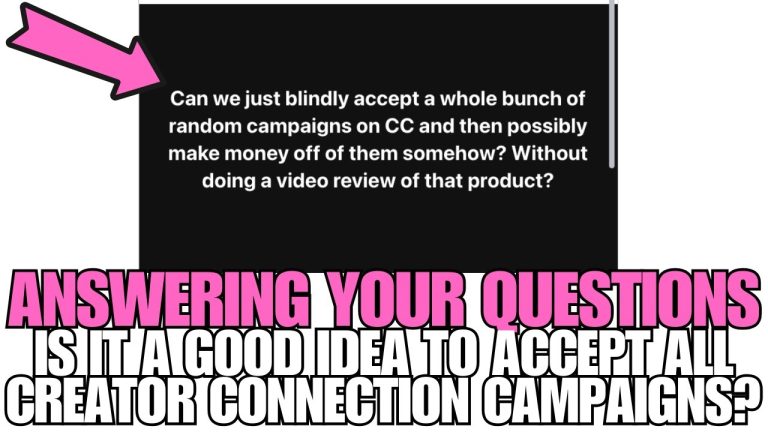
All right, Amazon influencers, I’ve got some bad news for a lot of you. If your product research strategy still revolves around how many influencer videos are sitting on a product, you’re running an outdated playbook — and it’s costing you money. I used to obsess over influencer video counts. It was the centerpiece of how I picked products. Today I barely glance at that number, and I’m making more than I ever did chasing “zero competition” listings. Let me walk you through why my whole approach changed, and what I look at instead.
In This Article
- The Product Research Rule I Used to Live By
- Why Video Count Mattered Before Creator Connections
- What Creator Connections Actually Changed
- The Number I Actually Watch Now
- Why I Stopped Fearing Oversaturation
- The 10% Commission Reality
- How I Vet a Campaign Today
- My Final Advice on Video Counts
The Product Research Rule I Used to Live By
For a long time, my product research came down to one ruthless filter: how many influencer videos are already on this listing? If there was more than one, I was usually out. If there was even one, I was probably out. I wanted to be the only creator on that product, full stop. I built my entire selection process around finding listings that were selling well, had a second carousel, and had little to no influencer competition. That was the holy trinity. I preached it for about two years, and at the time, I was right.
Why Video Count Mattered Before Creator Connections
You have to remember the world we were operating in back then. Creator Connections didn’t exist for Amazon influencers yet. All we had was the standard influencer commission, which averaged around 2% on a sale. Think about what that means. At 2%, you don’t make real money on a single burst of attention — you make it by selling a lot of something over a long period of time.
The only way to get that long exposure window was to be the dominant video on a product. If you were the only influencer video in the carousel, you held that visibility for the long term, not just a few days. So the video count wasn’t some vanity metric — it was the mechanism that protected your earnings. Low competition meant durable placement, and durable placement meant compounding commissions on a 2% rate. That’s why I told everyone to walk away from a listing the moment it had real influencer competition.
What Creator Connections Actually Changed
Then Creator Connections showed up and quietly broke my old model. When you’re chasing brand collaborations and elevated commission rates through campaigns, the influencer video count just doesn’t carry the weight it used to. The money no longer comes primarily from owning a carousel for months at a 2% trickle. It comes from getting onto the right campaign, at the right commission rate, while there’s still meaningful time left to earn on it.
That shift flipped my priorities completely. I went from being obsessed with how crowded a product was to being obsessed with the campaign behind it. The product is almost the secondary consideration now. The opportunity attached to it is the main event.
The Number I Actually Watch Now
Here’s the metric that replaced video count in my brain: days remaining on the campaign. I’m looking at that number constantly. Influencer video count? Basically never. For me, the threshold is a minimum of 60 days left on a campaign. If a campaign has that kind of runway, I’ll take a shot at the product even if it looks oversaturated, because I only need a small window of exposure to make it worth my while — four, five, maybe six days of good placement.
This is exactly the kind of thing I built Oink’s Comparison Video Schedule and campaign tracking around. Instead of manually eyeballing how many days are left and whether a campaign is worth your time, you want a system surfacing the campaigns with the most runway and the best terms — so you spend your filming time on opportunities that can actually pay, not on listings that just happen to look uncrowded.
Why I Stopped Fearing Oversaturation
Let’s be honest about what Creator Connections is. It’s a place where a lot of people are going to get the same product. The brand is sending out samples, and you are not the only person getting that item for free. Other creators are getting it too, and they’re all going to make videos. That product is going to get oversaturated shortly after you film it. That’s not a bug — that’s just the nature of the program.
Once you accept that, the old fear of competition stops controlling your decisions. You’re no longer trying to be the lone video on a product forever. You’re trying to capture a slice of a campaign while it’s live and well-funded. Oversaturation only scares you if you’re still playing the 2% long-game. On a campaign, it’s just background noise.
The 10% Commission Reality
Here’s the math that makes the new approach work. At a 10% commission baseline on Creator Connections — five times that old 2% standard rate — you can make really good money on a product that’s already selling well, even with very little exposure. I don’t need months of carousel dominance. I need a strong product, a campaign with time on the clock, and a few days of visibility. That’s it.
When the rate is that much higher, the entire calculus around competition collapses. A “crowded” product on a 10% campaign with 60-plus days left will out-earn a pristine, zero-competition listing on the standard rate almost every time. That’s the part a lot of influencers haven’t internalized yet.
How I Vet a Campaign Today
My current process is simple, and it’s the backbone of how I think about the 5 Pillars system inside Oink. First, is the product actually selling? A great campaign on a dead product still earns you nothing. Second, does the listing still have an upper carousel where my video can land? Third — and this is the big one — how many days are left on the campaign and what’s the commission structure? If the runway is healthy and the rate is strong, I’m in.
Tools like Storefront Cross Check and Unavailable Video Matching keep my storefront clean and my catalog working while I focus on the campaigns that matter, instead of burning hours hunting for unicorn low-competition products that pay pennies. The goal is to point your energy at opportunity, not at avoiding other creators. If you want the full system, it’s all at oinkforinfluencers.com.
My Final Advice on Video Counts
So here’s my final piece of advice. If you’re doing product collaborations on Creator Connections, ignore the video count. Yes, still target products that have an upper carousel so your video has somewhere to live — but stop letting the number of competing influencer videos make your decisions for you. Pay way more attention to the campaign itself: how much time is left, what the commission rate is, and how much opportunity that combination actually represents. That’s the shift that took me to five figures a month, and it’s the shift most influencers are still afraid to make.
If this changed how you think about product research, that’s exactly what Oink for Influencers is built for — finding the campaigns and products actually worth your filming time, instead of chasing competition counts that no longer pay. Come check out the full toolkit at oinkforinfluencers.com and start picking products the smarter way.