Storefront audit requests keep rolling in, and this one from a busy mom creator is a great example of what a good-but-not-yet-great storefront looks like. I ran it through the Oink storefront scan, which looks at your last 50 videos, and then watched her actual videos through a buyer’s eyes. Here’s what I found and what I’d change.
In this article:
- What the product data says
- Video length: make two videos per product
- Answer the buyer’s questions
- The toy problem
- Takeaways
What the product data says
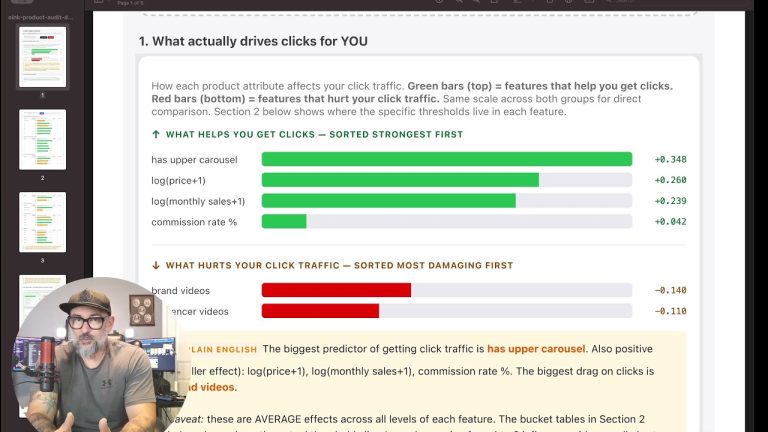
A quick note first: a lot is changing in the Amazon Influencer program, so I’m doing this audit with a grain of salt. It’s based on previous best practices weighed against where I think things are going. Here’s how the last 50 videos scored:
- Products with sales history: 37 of 50 have a product that’s selling. That’s pretty good. I’d like it closer to 80%, but I’ve seen plenty around 50%.
- Creator Connections campaigns: only 20 of 50. I’m giving it a C. I’m not as hellbent on Creator Connections as I used to be, but I’d like to see it closer to 50%.
- Average price: about $40, right where mine is. No real takeaway.
- Average monthly sales: around 1,288 units. This should be higher, closer to 2,000. It suggests too many products selling only 50 or 100 units.
- Upper carousel: 76%, a really good number, since upper carousels give better visibility.
- Influencer competition: about 4.71 influencers per carousel. I’d target closer to four. Combined with lower sales, that’s a bit problematic, but the fix is better products, not chasing this number directly.
Video length: make two videos per product
Her average video is 41 seconds. I’m not a believer anymore that longer is always the winning formula, but a 41-second average means she has hardly any long videos. My advice: make at least two videos on every product going forward. First, an anchor video of about two minutes that answers every question a buyer could have. Second, the 30 to 45 second vertical video for people on the go.
Answer the buyer’s questions
Many of her videos feel like TikTok reposts: short, fast edits. Amazon buyers want something different. They want to feel better about the money they’re about to spend. Take her wooden castle train set video. It focused on how much her kids enjoy it, but a buyer wants to know whether it’s a pain to put together, how big it actually is, and if it’s worth the price. Same with her bubble machine: she mentioned batteries are included and that it comes with spare bubbles, which adults want to know, but not what it’s made of or whether it feels cheap.
Personal and kid reactions are fine as context, but people assume kids will like a toy. Put yourself in the buyer’s shoes. A few more fixes:
- Shoot clothing videos vertically, since that’s the shape of the body.
- Show products in use. For makeup, shampoo, or soap, don’t just talk about it. Demonstrate it doing the job it was made for.
The toy problem
Her storefront leans heavily into toys because there are kids in the house and they’re easy to film. The issue is that toys typically carry lower commission rates, and without Creator Connections campaigns on most of them, a low-commission category is doing a lot of the lifting. I’d like to see more diversification. If you’re getting the toys anyway, still make the video. Just don’t pursue toys specifically for commission.
On the positive side, her videos sound and look good, and she’s in them more now, which wasn’t the case early on. She’s clearly turned a corner.
Takeaways
Pick products that actually sell, make an anchor video plus a short vertical for each, answer the questions a buyer would ask, and diversify beyond low-commission categories. Want the same scan on your own storefront? Check out Oink for Influencers. Watch the full audit below.
Ready to level up your product research? Get started with Oink for Influencers today.