Five months ago Jana asked me for an Amazon influencer storefront audit. I’ve been busy, a lot has happened, but I’m working through the list and this one needed to get done. I’m also going to be more blunt than usual, because these are some of the worst product-selection numbers I’ve seen in any audit I’ve run, and if the Amazon Influencer Program is your main thing, you need to hear this with the loving intent it’s delivered with. Here’s what I found across the last 50 videos, and what I’d fix first.
In This Article
- How I Audit a Storefront
- Only 24% of Videos Have a Product That’s Selling
- 276 Units a Month Is Not a Real Product
- The Clothing Trap: 7.5% Upper Carousels
- Creator Connections at 50% Needs to Be 80
- The Videos Themselves Are Good
- Unboxing, Audio, and the Intro Problem
- Competing for the Click
- Watch the Full Audit
How I Audit a Storefront
Every audit starts the same way. I pull the last 50 videos on the storefront and look at the products tagged in them, because products are the anchor for everything in this program. Bad products equal bad money. Good products can equal good money. I’m looking at sales history, Creator Connections coverage, average price, monthly unit volume, and whether the product even has an upper carousel for your video to appear in.
One caveat before the numbers. If you’re creating content for another platform first and just cross-posting to Amazon for whatever extra commissions come in, these metrics matter less. But if Amazon is your main focus and you’re choosing products for the program, this is the angle I’m taking.
Only 24% of Videos Have a Product That’s Selling
Out of the last 50 videos, only 12 have a tagged product with any sales history. That’s 24%. The other 76% of the videos are attached to products that aren’t moving.
I say this constantly: if the product isn’t selling, you can’t make money. Amazon can’t make money, which means Amazon has nothing to pay you from. When three out of four of your videos are sitting on dead products, no amount of effort on the video itself fixes the math. This is the single biggest problem on the storefront and everything else is downstream of it.
276 Units a Month Is Not a Real Product
Even when a product in those 50 videos is selling, it’s averaging only 276 units a month. When I run these audits the typical range is 2,500 to 3,500 units a month. An average of 276 tells me a lot of these are moving maybe 50 units a month, which is barely a product.
Two action items here. First, stop making videos for products with no sales history at all. Second, set yourself a baseline: a product needs to be selling at least 100 units a month before it earns a video. That floor alone would have screened out most of what’s dragging this storefront down.
Average product price was about $30. I’m not a big believer that price matters much, and that’s close to my own average, so no notes there.
The Clothing Trap: 7.5% Upper Carousels
Only 7.5% of the ASINs tagged have an upper carousel. That’s the lowest number I’ve ever seen, and the reason is clothing. Amazon doesn’t give clothing an upper carousel. Nobody knows why, but it’s clothing, shoes, and a handful of other categories. So every time you make a clothing video, the only place it can appear is the lower carousel, which means the buyer has to scroll way down the product page to ever see it, and most of them don’t.
You’re working with products that have little or limited visibility by design. When there is an upper carousel, you’re seeing about 4.5 influencers in it, which is normal since the cap is five. Only 21% of tagged ASINs have a sales history, which lines up with the 24% number above. Everything points the same direction: from an on-site perspective, these videos aren’t making much money and probably never will unless product selection changes.
Creator Connections at 50% Needs to Be 80
24 of the last 50 videos feature products with Creator Connections campaigns. That’s roughly 50%, and it tells me you’re not committed to Creator Connections products. You’re taking whatever you can get. I want that number up around 80%. Creator Connections isn’t optional anymore if you want to make good money as an Amazon influencer. It’s a requirement.
Which means: stop saying yes to so many brand opportunities. If a brand is paying you separately, fine. But if Amazon is your main income and the product isn’t selling, isn’t on Creator Connections, and doesn’t have an upper carousel, saying yes costs you the time you could have spent on a product that pays. This is exactly what Storefront Cross Check in Oink is built for. It runs your tagged products against sales history and live campaigns so you can see the 24% and the 50% before you’ve made the videos, not after.
The Videos Themselves Are Good
Here’s the good news, and it’s real. When I watch the videos I’m looking for authority, expertise, insight, and demonstration, plus whether you’re connecting with the buyer and whether the quality holds up. On the demonstration side, this storefront does a great job. The socks get put on. The clothing gets worn. On one product she goes through the full assembly and then shows the finished result. That’s showing the product doing what it was designed to do, and it’s what converts.
Everything is shot horizontal, which I have no issue with, and it tells me this content was probably made for Amazon rather than cross-posted from TikTok. With over 3,000 posts on the storefront, the work ethic is obviously there. The effort just needs to be pointed at better products.
Unboxing, Audio, and the Intro Problem
Three tweaks on the content itself. First, I’m not a fan of unboxing. Opening the package on camera tells the buyer you have zero context for this product, which is the opposite of expertise. Assembly is fine, but show it as a separate clip: here’s what it looked like when I put it together, and here’s what it looks like now. Don’t make it look like you assembled it thirty seconds ago.
Second, audio. The video quality is good, but almost none of the videos use a mic, and the room most of them are shot in is big and echoey. I had to crank my volume. Great information that buyers can’t hear sends them straight to the next video in the carousel. Every serious content creator should own a lavalier mic and use it on every single video. If the product is worth a good video, it’s worth good audio.
Third, the intro. Nearly every video opens with “Hi, I’m doing something with this, and the brand sent it to me.” Buyers don’t care about any of that. Use that first moment to connect: “You’re probably wondering, does this dress actually fit? Is it comfortable? What’s the material like? The brand sent it to me so I can show you.” Lead by telling them they’re in the right place. Mention the brand after.
Competing for the Click
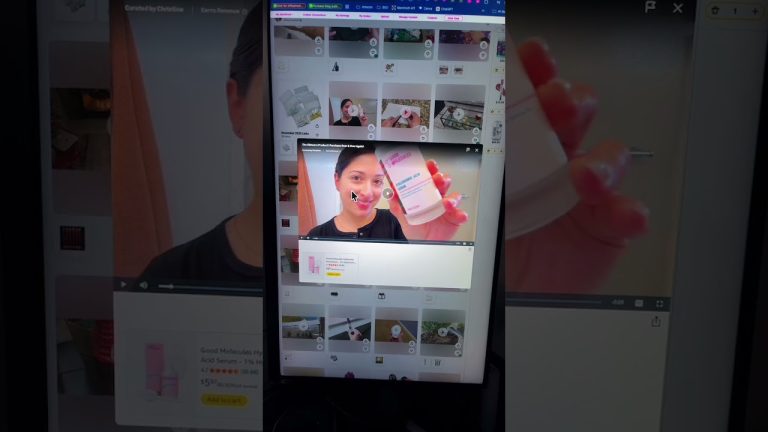
Once you’re in a carousel, buyers see two things: the thumbnail and the title. The thumbnails here are already excellent. They highlight the product and tell the story of the video. Don’t change a thing.
Titles need work. A title like “nipple covers with lift” doesn’t do anything, because the buyer already knows what the product is. Ask the question they’re asking: “Does this thing actually stay put?” The one titled “try on review” is closer, because it promises an opinion. Use the title to create a reason to click your video over the four others sitting next to it.
Watch the Full Audit
If you want to see your own 24% before it costs you another quarter, run a Storefront Cross Check inside Oink for Influencers. It’ll tell you which of your tagged products are selling, which are on Creator Connections, and which ones you should stop saying yes to.