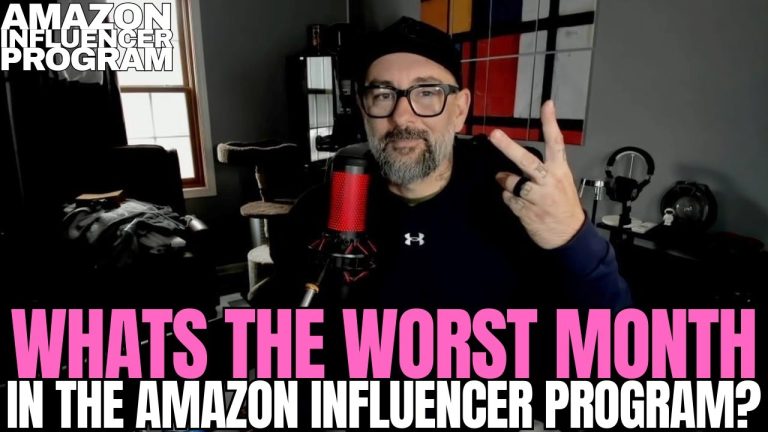
If you opened Creator Studio this week and saw a message saying your videos are “no longer eligible for on-site product placement,” you are not alone. I just did another video on the global storefront rollout, because this has been one of the most confusing launches I’ve seen from Amazon. Here’s what I’m seeing, what I think is behind it, and what you can actually do.
In this article:
- What people are seeing in Creator Studio
- The “doing too much” theory
- Why volume alone doesn’t explain it
- Ghost videos and duplicates
- What happens next
What People Are Seeing in Creator Studio
Over the last 48 hours, a bunch of Amazon influencers started seeing a notice saying they still have a storefront, but the videos on it are no longer eligible for on-site placements because of quality and guideline issues. Because of the timing, a lot of people connected it to the global storefront merge. A couple of days ago I wasn’t ready to draw that line, because we’ve seen this exact messaging before for other reasons. Now I’m ready: I believe this is connected to the global storefront changes.
The “Doing Too Much” Theory
Historically, this message showed up for creators who cross-posted huge numbers of videos into other countries, manually or with automation. If Amazon thought you were adding too much to a storefront too fast, you’d get flagged. Amazon never published a number for what “too much” means, so it just appeared out of nowhere, and it was confusing until a second message surfaced that put a label on it: volume.
When people shared their stories with me, every single one had done large-scale cross-posting. In the early cases, creators got their on-site eligibility back and started returning to carousels after about 10 days. More recently some people waited close to 60 days with no explanation. Don’t assume your timeline will match either one, because placement can vary product to product and nothing is guaranteed.
Why Volume Alone Doesn’t Explain It
Here’s where it gets interesting. A lot of the people getting this message never cross-posted at all. One creator told me they uploaded around 40 videos and hadn’t touched their storefront in four months, and they still got flagged. The only volume happening right now is Amazon’s own merge, and it isn’t hitting everyone. I opted in about two weeks ago the moment I got the “you’re in the US” button, and I haven’t seen it.
My read: a sudden flood of videos moving around may have triggered Amazon’s bot-detection AI, which exists to stop people from bulk uploading with bots. There’s also a smaller possibility that some accounts already had a quality issue and the merge put everything under a magnifying glass. I don’t think that’s the main cause because of the “doing too much” label, but I’m keeping it on the table. The most likely explanation is simply a bad implementation of the merge.
Ghost Videos and Duplicates
Another odd thing: even after a video disappears from your storefront, you can often still reach it through the old link and edit it in Creator Studio. They’re like ghosts of your storefront videos. Some creators are also seeing duplicate flags. I don’t have duplicates myself and I’m not sure how much weight to put on that, since those tags may have existed before and are only visible now that everyone is looking closely.
What Happens Next
Honestly, Amazon is in complete control here. Documentation is unclear and support channels haven’t been helpful, so all we can do is document what we see and stay consistent. Keep making good content, don’t panic-delete your storefront, and keep an eye on Creator Studio. If you want to track your storefront’s health and spot problems earlier, that’s exactly the kind of thing we build into Oink for Influencers.
Want to find products that actually earn, while the platform sorts itself out? Try Oink for Influencers and put your time where the commissions are.