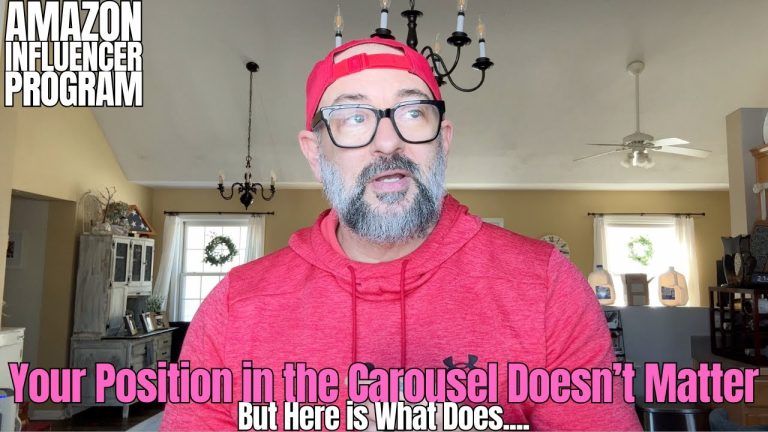
I’m about to argue against myself, and I want it on record. For months I’ve been telling every Amazon influencer who would listen the same thing: Creator Connections is the game. Chase the campaigns, stack the bonuses, that’s where the commissions live. I still think campaigns are great. But I hit five figures in a month with basically zero Creator Connections commissions, and that number forced me to go back and question my own advice.
Table of Contents
- The Receipts: $2,000 My First Month, Five Figures a Year Later
- Why This Matters Most If You’re New
- Yes, I Know the Commission Rates Changed
- Which Categories Are Still Worth Chasing in 2026
- Open Carousels: The Opportunity Nobody Talks About
- How I Actually Pick Products Now
- Where I Might Be Wrong
- What To Do This Week
The Receipts: $2,000 My First Month, Five Figures a Year Later
In my first month as an Amazon influencer I made just over $2,000. That was before I understood half of what I understand now. A little over a year later I hit five figures in a single month. Here’s the part that matters: that second number came almost entirely from straight Amazon affiliate commission — onsite earnings and my storefront. Not campaign bonuses. Not Creator Connections payouts.
Same program. Same concept. Same kind of videos I’d been making the whole time. The difference wasn’t a secret campaign or an invite-only bonus tier. The difference was product selection.
I’m not sharing that to flex. I’m sharing it because when I look at the advice I’ve been giving — including my own — the whole conversation has drifted toward campaigns as if onsite commission stopped existing. It didn’t. It’s still sitting there, and for a lot of creators it’s the more reliable half of the business.
Why This Matters Most If You’re New
If you just got into the Amazon Influencer Program, here’s your reality: you can’t get campaign approvals yet. Brands want to see history. Your acceptance rate is going to be rough for a while. And every piece of content you consume is telling you that the money is in a thing you’re structurally locked out of.
That’s a demoralizing place to start. I’ve watched people quit in month two over it. And it’s built on a premise I no longer fully believe.
You do not need Creator Connections approval to make money. You need products people are already buying, with room in the carousel for your video to be seen. Those two conditions are available to a brand-new account on day one.
Yes, I Know the Commission Rates Changed
This is the first thing someone’s going to say in the comments, so let me get ahead of it. The rates changed. A bunch of categories got cut. I’m not pretending that didn’t happen or that it didn’t hurt.
But “the rates changed” and “onsite commission is dead” are two very different claims, and people keep collapsing them into one. The 2%, 3% and 4% categories still exist. There are still an enormous number of products sitting inside them. If you’re deliberate about which categories you work in — instead of just filming whatever showed up on your doorstep — the math still works.
The creators complaining loudest about rates are usually the ones who never chose a category in the first place. They let the products choose them.
Which Categories Are Still Worth Chasing in 2026
I’m not going to hand you a list and tell you to go film it, because a category is only good if it’s good for you — your niche, your audience, the stuff you can talk about without sounding like you’re reading a box. But here’s the framework I use:
- Check the rate first, not last. Before you get attached to a product, know what percentage it pays. A great video on a 1% product is a worse business decision than a decent video on a 4% product.
- Weight it against price point. Four percent of a cheap item is nothing. The sweet spot is a healthy rate on something with real order value, in a category people repeat-buy.
- Confirm it actually sells. Rate and price mean nothing if the product has no sales history. Demand is non-negotiable.
- Then look at the carousel. Which brings me to the part most people skip entirely.
Open Carousels: The Opportunity Nobody Talks About
Right now, today, I’m looking at products with wide open carousels and no Creator Connections campaign attached at all. Nobody’s competing for the slot. There’s no campaign pulling in fifty creators to fight over placement. The video position is just… sitting there.
Think about what that means. On a product with a crowded carousel, you’re the ninth video and nobody scrolls that far. On a product with an open carousel, you’re the first thing a buyer sees when they’re already on the page with their wallet out. Same effort on your end. Wildly different outcome.
The catch is that finding those products by hand is miserable. You’d be opening product pages one at a time, counting videos, checking sales signals, cross-referencing categories. That’s exactly the problem I built Oink to solve — surfacing products that sell, in categories that pay, with carousel room for your video to actually get seen. I got tired of doing it manually, so I stopped.
How I Actually Pick Products Now
My filter these days is embarrassingly simple, and I think that’s why it works:
- Does it sell? If there’s no demonstrated sales history, I don’t care how pretty the product is.
- Does it pay? I want to be in a category where the percentage justifies the hour I’m about to spend.
- Can I get seen? Carousel room, and ideally upper placement.
- Can I say something real about it? If I can’t answer the buyer’s actual question, the video won’t convert no matter how good the first three look.
Notice that “is there a campaign attached” isn’t on that list. If a campaign shows up, great, it’s a bonus on top. But I stopped letting it be the entry requirement.
Where I Might Be Wrong
I want to be honest about the other side of this, because I’m questioning my own take here and it would be pretty weak to only argue one direction.
Creator Connections campaigns can pay dramatically better per unit than base commission. For established creators with high approval rates, that gap is real and it’s large. If you’ve built that access, throwing it away because a guy on YouTube said onsite commission still works would be a bad trade. And my own results are one person’s data — my niche, my audience, my year. Yours may not behave the same way.
What I’m actually arguing is narrower than “Creator Connections is overrated.” It’s this: treating campaigns as the entire game is a mistake, and it’s a particularly expensive mistake for new creators who can’t access them yet.
What To Do This Week
- Pull up your last ten videos and note the commission category for each one. Be honest about how many you picked without checking.
- Find three products in a 3% or 4% category that have real sales history and fewer than a handful of videos in the carousel.
- Film those three. Don’t wait for a campaign approval.
- Compare the onsite earnings from those three against your last three campaign videos in thirty days.
That’s it. Run the experiment on your own account instead of taking my word or anyone else’s.
Find the Products Worth Filming
Everything above comes down to one skill: knowing which products deserve your time before you spend it. That’s the whole reason Oink exists. It’s the product research tool I built for myself as an Amazon influencer, so I could stop guessing about sales history, commission categories and carousel room, and start filming with the answer already in hand.
If you’re new and you feel locked out because the campaign approvals aren’t coming yet — you’re not locked out. You’re just looking at the wrong door. Go find the open carousels.
And if you think I’m wrong on this one, tell me. I put this take on record specifically so it could be argued with.