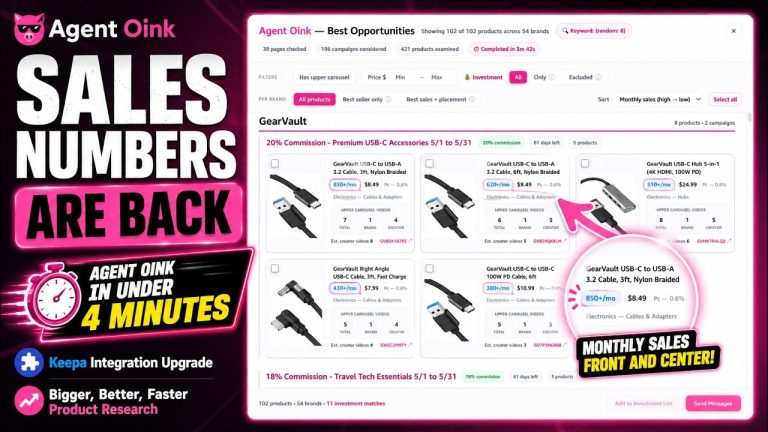
This week I had two separate conversations with people who each pulled in almost $30,000 in the Amazon influencer and affiliate program over the last 30 days, with most of it coming from the influencer side. When I asked each of them what they were actually doing to hit those numbers, they said almost the exact same two things. One of those things I have been hammering on this channel since April, and it mattered enough to me that I built a feature inside Oink specifically to help you do more of it. Let me break down exactly what these two earners are doing so you can copy it.
In This Article
- Two Earners, Almost $30k in 30 Days
- Why These Numbers Matter After the Spring Changes
- Habit One: Targeting Products in Multiples
- Habit Two: Going In-Depth Instead of Quick
- The Data on Longer Watch Time and Carousels
- How Oink’s Comparison Video Schedule Does the Heavy Lifting
- Putting the Two Habits Together
- My Takeaway
Two Earners, Almost $30k in 30 Days
I want to be clear up front: these are real numbers from real creators, not screenshots from some course being sold to you. Two different people, two different conversations, both landing right around $30,000 in commissions in a single 30-day window, and the bulk of it earned on the Amazon influencer side rather than classic affiliate links. What struck me was not just the size of the numbers. It was that when I pressed both of them on what they were actually doing day to day, their answers overlapped almost perfectly. Two habits. That is it. No secret category, no gaming the system, no luck. Just two repeatable behaviors that anyone reading this can start applying to their own storefront this week.
Why These Numbers Matter After the Spring Changes
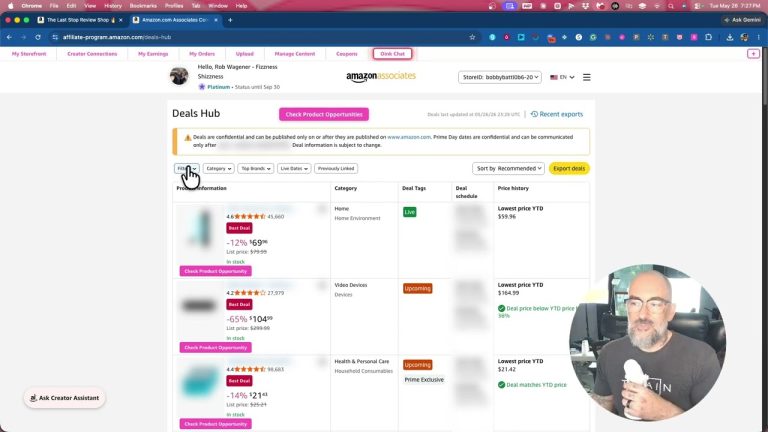
These numbers land even harder when you remember where we were a few months ago. Back in March and April, Amazon dropped a run of changes that were genuinely hard to swallow. They reduced influencer commission rates, they got rid of related sales, and they overhauled the reporting in a way that also killed off the daily sales data a lot of us relied on. At the time, plenty of people declared the programs dead and started looking for somewhere else to pivot. I said no, repeatedly and on camera. My argument was simple: if you are willing to listen to what Amazon is actually telling you it wants from you, I could see a scenario where six months down the road people would be making more money than they were before those changes ever happened.
That six-month mark is now only about three months away, and here we are with people reporting some of the strongest 30-day windows I have seen. That is not a coincidence. Amazon has been nudging creators toward exactly the kind of content these two earners are producing. The people who leaned in instead of bailing out are the ones cashing the checks right now.
Habit One: Targeting Products in Multiples
Here is the first habit, and it starts all the way back at product research. Most creators approach research one product at a time. They grab a pair of sunglasses, then a vacuum, then a flashlight, one-off items scattered across unrelated categories. These two earners do the opposite. When they target a product, they target it in multiples on purpose. They are not thinking, “Today I got a vacuum.” They are thinking, “Today I got four vacuum cleaners,” because they are setting up their product research with the explicit intention of creating comparison videos.
That intention is the whole game. It is not, “Well, maybe if I end up with a few vacuums I’ll do a comparison.” It is, “I am acquiring these specifically to compare them.” And it does not matter whether the products come through Creator Connections messaging or whether they are buying the items outright. Either way, they deliberately gather several similar products in the same category so the comparison content is baked in from the start. That single shift in how you approach research changes everything downstream.
Habit Two: Going In-Depth Instead of Quick
The second habit is the one I think is actually gluing all of this together, and it shows up the moment you look at their storefronts. Their videos are not 30-second or one-minute quick clips. On average their videos run a baseline of two to three minutes, and that is the floor, not the ceiling. And to be clear, they are not padding runtime just to make long videos for the sake of length. They are making good, in-depth videos that demonstrate real experience, authority, insight, and hands-on demonstration.
This is where so many creators miss the mark. The instinct is, “I just need to hurry up and get a video posted so I have coverage on this product.” That approach is not converting anywhere near as well anymore. A rushed, shallow clip tells Amazon and the shopper nothing. A thorough walkthrough that actually shows the product in use tells them everything, and it keeps people watching.
The Data on Longer Watch Time and Carousels
I am not asking you to take the “longer is better” idea on faith. Over the past year we have seen a couple of independent data sets come out that support it directly. Data Coach Cla ran one analysis and McKay ran another, and the two lined up remarkably well, both pointing at the same conclusion: longer videos, which naturally create longer watch-time opportunities, tend to perform better in the Amazon carousels.
Think about why that makes sense. A two-to-three-minute comparison gives a shopper a genuine reason to stay and watch, and that extended watch time is a signal. So the in-depth habit is not just about quality for quality’s sake, it feeds the exact metric that seems to help your content surface more often. Depth and distribution reinforce each other.
How Oink’s Comparison Video Schedule Does the Heavy Lifting
Here is why I brought up April at the top. The comparison-video habit is exactly the thing I built a feature for inside Oink, because doing it manually gets overwhelming fast. The feature is the Comparison Video Schedule. You go in and select the similar products you want to compare, say you pick out all the flashlights you have on hand, and you can grab several of them at once. Then you click the button that says generate comparison list.
From there Oink fetches the product details for however many items you selected and hands you back a full comparison schedule. It maps out every combination of comparison videos you could realistically create from that set of products. In one example I ran, I selected six flashlights and Oink showed me somewhere around 35 different comparison videos I could make from just those six items, because you can pair and group them in so many combinations. That is the difference between hoping you find comparison angles and having a whole content calendar generated for you. You bring the products; Oink tells you exactly which videos to shoot.
Putting the Two Habits Together
Individually, each habit helps. Together, they compound. Habit one, targeting products in multiples, guarantees you always have comparison material on hand instead of a drawer full of unrelated one-offs. Habit two, going in-depth, makes each of those comparison videos genuinely watchable and gives it the watch time that helps it surface in the carousels. And the Comparison Video Schedule ties the two together by turning a pile of similar products into a concrete list of videos to produce.
This is the same logic behind the 5 Pillars approach I teach and the storefront tools inside Oink like Storefront Cross Check and Unavailable Video Matching. It is all about being deliberate: research with intent, produce with depth, and keep your storefront working instead of hoping the algorithm notices you. The people making the biggest numbers right now are not doing anything you cannot do. They are just doing these things on purpose and at volume.
My Takeaway
Those are bonkers numbers, and huge congrats to the two creators behind them. But the reason I wanted to share this is that neither of them is doing anything exotic. They target products in multiples so comparison content is built in, and they make in-depth videos that earn watch time and carousel placement. That is the whole formula, and the Amazon changes from the spring have made it more true, not less. If you have been waiting for a sign to change how you approach product research and video length, this is it.
If you want to put the comparison-video habit to work without the manual headache, that is exactly what the Comparison Video Schedule inside Oink is built for. Select your similar products, generate your comparison list, and get a ready-made shooting schedule that keeps your storefront full of the kind of in-depth content that is paying off right now. Head over to oinkforinfluencers.com to get started and start turning your product research into real commissions.