There are more people than ever on TikTok, YouTube, and Facebook dispensing advice about the Amazon Influencer Program, and most of you have no way to tell who knows what they are talking about. I have thought about this a lot, and I think I have a test that works. It is one question, and it does not require you to know anything about the person giving the advice. It only requires you to know what the program is actually for.
In This Article
- The One-Question Test
- What the Program Is Actually For
- Parent IDs: The Hack That Was Never Worth Much
- Blind-Accepting Creator Connections Campaigns
- The 30-Videos-Per-Product Carousel Play
- Gamified Is Not the Same as Gaming
- What I Saw in My Own Numbers Two Weeks Ago
- Why Undocumented Strategies Are the Most Dangerous
- How to Build a Strategy That Survives the Next Change
The One-Question Test
Here is the test. When someone gives you Amazon Influencer advice, ask yourself: does this move me closer to the purpose of the program, or further away from it? The further a strategy drifts from what the program has consistently been for years, the more likely it is that you are looking at a system-gaming trick dressed up as strategy. It might work. It might even work well for a while. But it is not the Amazon Influencer Program anymore. It is something else that happens to use the program as a vehicle.
That does not mean everyone giving advice is trying to get one over on you. Most people mean well. The community is just noisy, and noise makes it hard to separate the serious people from the people who found a loophole last month.
What the Program Is Actually For
Go read it in Creator University. The Amazon Influencer Program exists to help buyers make purchase decisions through informative videos, and Amazon wants you to do that as much as you can. Since the program’s inception, the common thread for everyone who has made real money has been the same: consistently make content on products that are selling.
Creator Connections is a bonus program layered on top of that. You accept a campaign, you promote those products, you make content for them, and you earn a bonus on the conversions. That is the whole design. Every strategy I trust can be traced back to one of those two sentences.
Parent IDs: The Hack That Was Never Worth Much
I will own this one, because I was the one who started talking about parent IDs in 2025. People grabbed onto it and ran, not because the value was large (it was minimal then and it is smaller now) but because it felt like gaming the system. It felt like an edge. Within weeks people were teaching it as an integral part of an overall plan, which it never was.
Today parent IDs are getting harder and harder to tag, and I fully expect Amazon to make them untaggable or pull them off storefronts entirely at some point. If your plan has parent IDs anywhere near the center of it, you built on sand. If they are a small footnote in a plan built on converting products, nothing happens to you when they disappear.
Blind-Accepting Creator Connections Campaigns
Right now the big one is Creator Connections. A lot of creators are blind-accepting every campaign they can see, with no intention of making content for most of them, because commissions attach to products they may sell anyway. It works. It is also a version of the same thing: it has nothing to do with the structure of the program, which is accept, promote, create, earn a bonus.
Everything is cool until it is not cool. If blind acceptance was your game and Amazon tightens the rules, which it has already started doing, you are suddenly in a situation that exists only because the game was being played outside the program’s purpose. I am not saying every change is caused by blind acceptance. I am saying that if that was your main strategy, you have no fallback when it stops working.
The 30-Videos-Per-Product Carousel Play
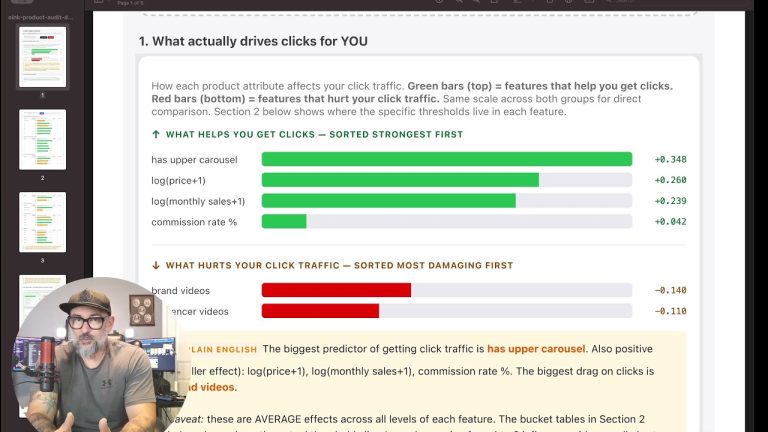
When the carousels started rotating fast at the beginning of last year, I had people telling me they were going to make 20 or 30 videos for a single product. The logic was that if videos are cycling in and out that quickly, it is a numbers game, so flood it. That is not a content strategy. It is not about making a better video. It is about making more of them to exploit whatever the carousel was doing that month.
Contrast that with the advice that longer videos were being prioritized. That is close to the core purpose. Make a good, informative video, and it happens to run longer because you are actually explaining the product. One of those strategies survives a change in carousel behavior. The other one does not.
Gamified Is Not the Same as Gaming
Let me be fair here. Parts of this program are gamified, and we all play at some level. Making a strong thumbnail so a shopper clicks your video over the one next to it is a game. I teach that. The difference is that nobody serious teaches thumbnails as the central strategy. They teach the video first, and the thumbnail is part of the process of getting that good video seen.
The problem starts when the gamified piece becomes the focus and the actual purpose becomes an afterthought. When that happens, you are prioritizing parts of the program that Amazon does not prioritize, and Amazon always wins that disagreement eventually.
What I Saw in My Own Numbers Two Weeks Ago
About two weeks ago my video view count started climbing noticeably. I usually make one or two videos per product, not thirty. When I went and looked at the carousels, they were not rotating fast anymore. They had slowed down big time. My first thought was about the creators who had spent the last month making 30 videos for a single product. If the carousel is no longer cycling, those videos may never see the light of day again. A month of filming, spent on a short-term window that closed.
This is exactly why I built the Comparison Video Schedule into Oink the way I did: it tells you how many videos a product can actually support based on what is happening on the page, instead of guessing or flooding.
Why Undocumented Strategies Are the Most Dangerous
Here is the part people underestimate. When a strategy exists outside the program’s documentation, when there are no rules for it according to Amazon, that is not a loophole you own. It is a loophole Amazon has not gotten around to closing. Nothing protects you. Amazon can show up one day and say “done,” and there is no appeal, because the thing you were doing was never a feature in the first place.
Short-term money is still money, and I understand the appeal. But I am not sure how valuable that money is if the strategy evaporates the moment it changes and you have to go find the next thing to game. That is not a business. That is a treadmill.
How to Build a Strategy That Survives the Next Change
Every time the program has shifted over the years, the creators who kept earning were the ones who stayed anchored to the core and pivoted the details. That looks like this:
- Find products that are already converting. That is what Oink’s product research and the 5 Pillars system are built for. Sales velocity, review momentum, and on-site video competition tell you where a good video will actually get seen.
- Make informative videos that help a buyer decide. One or two strong videos per product, not thirty. Use Storefront Cross Check so you are not duplicating what you have already covered, and Unavailable Video Matching to re-home videos when a product goes dark.
- Treat Creator Connections as a bonus, not a foundation. Accept campaigns for products you will actually promote. The bonus is real; the foundation is your storefront.
- Keep the gamified pieces in their lane. Thumbnails, titles, and timing matter. They support the video. They are not the plan.
- Diversify off-site. Your storefront, your groups, your Walmart links, your Trybe brands. If all your eggs are in any one basket, especially a basket outside what Amazon cares about, you are exposed.
So the next time someone on TikTok tells you about the new trick, run the test. Is this closer to “consistently make content on products that convert and help buyers decide,” or further from it? If it is further, enjoy it while it lasts, but do not build your income on it.
If you want tools built around the core of the program instead of the trick of the month, that is exactly what Oink is. Get it at oinkforinfluencers.com and build a storefront that is still earning after the next change.