I’m about to say something about Creator Connections that is going to ruffle some feathers, and I want it on the record right now — because six months from now, when everybody else is saying it, I want the timestamp.
Here it is: what if we’re wrong?
For months now — really since April and all the reporting changes — the message from me and from just about everybody else in this space has been the same. Creator Connections is the game. Focus on Creator Connections. Chase the campaigns. And I still believe that’s mostly right. But I’ve been sitting with something this past week that I can’t shake, and I’d rather share the doubt out loud than pretend I’ve got it all figured out.
In This Article
- The Story I Tell All the Time
- “But Fizz, the Commissions Changed”
- What I’m Actually Seeing Out There Right Now
- So Is Creator Connections Still the Game?
- What This Actually Means for Your Product Selection
The Story I Tell All the Time
I tell this story so often that I usually don’t hear myself saying it anymore. But last week I actually heard it come out of my mouth, and it stopped me.
In my first month as an Amazon influencer, I made over $2,000. A little over a year later, I hit five figures in a month for the first time. Right at about $10,000.
And I did it with basically zero Creator Connections. I should be honest — maybe $300 of that total was Creator Connections, because at the time we weren’t really using it as Amazon influencers. So call it $9,700 in straight Amazon influencer commissions. No campaigns. No brand deals stacked on top.
Sit with that for a second. Ten thousand dollars in a month, in a program built on making videos — the same program we still have today. Same concept. Same mechanics. Same carousels. And I got there without the thing we now all agree is the thing.
“But Fizz, the Commissions Changed”
I know. I’m aware. I hear it every time I tell that story, and it’s a fair objection. But let’s actually do the math instead of just waving at it.
Back when I hit that number, I was averaging around 2% commission across my catalog. Some products were at 1%. Some were at 3%. Very few were at 4%, because I wasn’t intentionally shopping in those categories. So let’s just call my blended average 2%.
Now here’s the part people skip. Yes, rates came down across the board. But 2% categories still exist. 3% categories still exist. 4% categories still exist. There are still a whole lot of products sitting in them.
So the honest question is this: if I made $10,000 at a 2% blended average with no Creator Connections, and 2%, 3%, and 4% categories are still on the board today — can you still build a 2% blended average?
Yes. You can. You just can’t do it lazily anymore.
Back then, it averaged out to 2% almost by accident. I picked whatever I wanted and the math landed where it landed. Today you have to be deliberate. You have to go hunting for the twos, the threes, and the fours on purpose. But those products are absolutely still there.
What I’m Actually Seeing Out There Right Now
This isn’t just a nostalgia argument. It’s what I’m looking at on my screen every day.
I keep running into products with no Creator Connections campaign at all that have wide open upper carousels — good ones — and are selling three, four, five, six, seven thousand units. Nobody’s fighting for the slot. The visibility is right there. The sales velocity is right there. And the only thing “wrong” with the product is that there’s no campaign attached to it, so the entire influencer community has trained itself to scroll right past.
I did a call with my buddy John this week and showed him a handful of these. I said, “What do you think about this?” He’s probably making videos on them right now.
So Is Creator Connections Still the Game?
Let me be careful here, because I don’t want this taken further than I mean it.
Creator Connections is the game. I’m not walking that back. The math on a campaign product versus a non-campaign product is not close — a campaign stacks additional commission on top of what you were already going to earn, and the creators I see clearing $20,000 and $30,000 a month have Creator Connections attached to something like 90% of their videos. That’s not a coincidence.
What I’m questioning is whether it’s the whole game. Because right now, “does it have a campaign?” has quietly become the only filter a lot of people use. And when everybody filters the same way, everybody ends up in the same crowded pool — fighting over the same campaign products, in the same carousels, against the same creators.
Meanwhile there’s a whole shelf of high-velocity, open-carousel, decent-category products sitting there uncontested because they failed one binary check.
What This Actually Means for Your Product Selection
I’m not telling you to abandon Creator Connections. I’m telling you to stop letting it be your only criterion. Here’s how I’d think about it:
- Keep Creator Connections as your default. If a product has a campaign and it clears your other checks, that’s still the strongest play you have.
- Don’t auto-reject a no-campaign product. Run it through the rest of your criteria first — upper carousel, sales history, commission category — before you throw it out.
- Go hunting for category rate on purpose. The 3% and 4% categories are still there. Blended average is a lever you control.
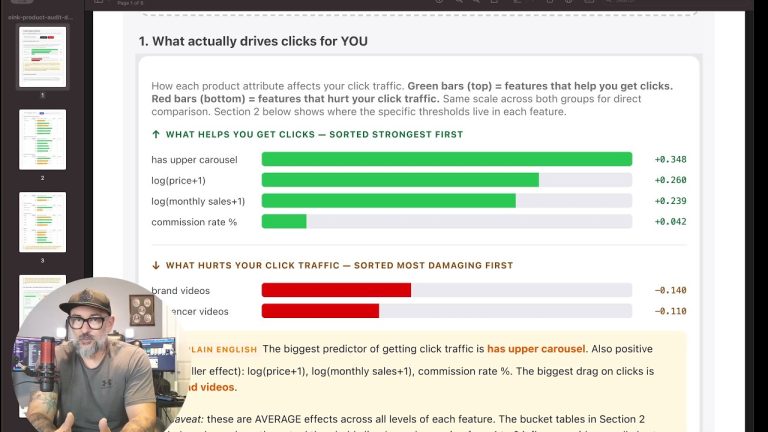
- Weight the upper carousel heavily. A no-campaign product with a strong open upper carousel and real sales velocity may beat a campaign product buried below the fold.
- Watch what happens over 30 days. Track a small batch of non-campaign, high-carousel products and see what they actually pay. Let your own data settle the argument.
This is exactly the kind of thing I built Oink to make visible. When you’re looking at a product page, you shouldn’t have to guess whether there’s an upper carousel, what the sales history looks like, what the commission category is, and whether a campaign exists. You should see all of it at once, and then you decide which trade-off you’re making. Filtering on one variable is only a strategy when it’s the variable nobody else is filtering on — and right now, everybody’s filtering on the same one.
I might regret saying this in a couple of days. I’m going to let it soak. But I’d rather be publicly uncertain and right than confidently repeating a consensus I’ve stopped fully believing.
Stop Guessing, Start Scanning
If you want to test this for yourself, you need to be able to see all the variables on a product before you commit a video to it — not just whether a campaign exists. That’s what Oink does on any Amazon page: carousels, sales history, category, and campaign status, all in one look.
Grab Oink and go find the products everybody else is scrolling past.