Amazon just dropped a new AI disclosure checkbox into the Influencer Program, and within hours my inbox and comments were full of the same question: did Amazon just greenlight AI shoppable videos and ruin the program for the rest of us? Short answer — no. Take a breath. Nothing about your day-to-day changed today. But there’s a longer answer worth understanding, because how you react to this tells me whether you’re thinking like a creator or thinking like a business owner. Let me break down what actually happened, what it means for your commissions, and where AI might genuinely be worth your attention.
In This Article
- What Amazon Actually Changed
- Why the AI Disclosure Checkbox Isn’t New Behavior
- Can AI Shoppable Videos Actually Convert?
- How the Rotating Carousel Decides Who Stays
- Where AI Is Actually Worth Your Time
- Buyer Intent, Authenticity, and Authority Still Win
- Creator vs. Business Owner: Finding the Balance
- What You Should Do Right Now
What Amazon Actually Changed
Here’s the whole thing in plain language: when you upload a shoppable video now, Amazon shows you a checkbox asking whether the content was generated or meaningfully altered using AI. That’s it. There’s no new policy banning anything, no commission penalty attached to checking the box, and no email telling you your old videos are at risk. Amazon added a disclosure field — the kind of thing platforms add when they want to cover themselves legally and start collecting data on a trend before it gets big.
The panic came from people reading “AI disclosure checkbox” as “Amazon now allows AI to flood the carousel.” Those are two very different statements. A disclosure requirement is not an endorsement. It’s Amazon getting in front of something, the same way every major platform has rolled out AI labeling over the last year.
Why the AI Disclosure Checkbox Isn’t New Behavior
People were already using AI tools inside the program long before this checkbox existed — for scripts, for editing, for thumbnails, for product research. Amazon didn’t suddenly invent AI in the influencer space. What they did was add a place to declare it. If anything, this is Amazon acknowledging reality and trying to keep the carousel honest, not throwing the doors open.
Think about it from Amazon’s side. Their entire shoppable video program exists to drive purchases. They have zero incentive to fill the carousel with low-effort AI clips that don’t convert, because that directly hurts their conversion rate and their bottom line. The disclosure checkbox is a tracking and compliance tool, not a strategy shift that should change how you operate tomorrow morning.
Can AI Shoppable Videos Actually Convert?
This is the question that actually matters, and most of the panic skips right past it. A shoppable video only earns you commission if a real human watches it and buys the product. So the question isn’t “is AI allowed?” — it’s “does AI-generated content convince a shopper to pull out their card?”
In my experience, the answer right now is mostly no, at least not against a real creator who knows the product. When someone is hovering over a buy button, they’re looking for trust signals: a real hand holding the item, an honest reaction, a genuine “here’s what I didn’t like about it.” That buyer intent moment is where authentic creators crush generic AI footage. A polished AI clip that’s never touched the product reads as an ad. Your messy, real, in-hand demo reads as a recommendation. Recommendations convert.
How the Rotating Carousel Decides Who Stays
Remember how the carousel actually works. Amazon rotates videos through the slots on a product page and watches how they perform. Videos that earn clicks and conversions keep their placement and get shown more. Videos that don’t earn get rotated out. It’s a performance machine, not a popularity contest.
That mechanism is your protection. Even if the carousel fills up with AI content, the clips that don’t convert won’t hold their slots. The system is self-cleaning. Your job is to keep producing videos that earn their place — and to make sure you’re covering the right products in the first place. This is exactly why I lean on the Comparison Video Schedule and Storefront Cross Check features inside Oink: they keep me focused on products that have demand and slots worth competing for, instead of guessing.
Where AI Is Actually Worth Your Time
I’m not anti-AI. I use it every day to run this business by myself. The opportunity I’m watching isn’t AI shoppable videos — it’s AI for shoppable pictures and collages at scale. Static product imagery and clean collages are far less dependent on the human trust signal that video demands, and you can produce them quickly to cover a wider range of products on your storefront.
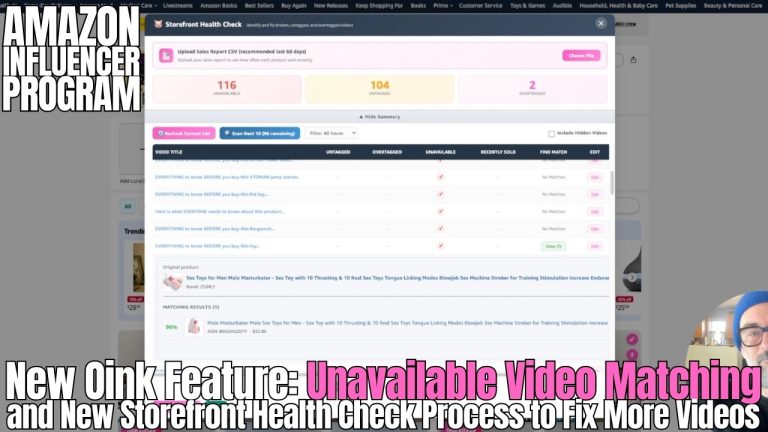
That’s where I’d point your experimentation: use AI to expand your coverage and fill gaps, not to replace the videos that are already earning. Pair that with Unavailable Video Matching in Oink so you can quickly spot where you’ve lost a placement and rebuild coverage, and you’re using AI as a productivity lever instead of a shortcut that tanks your conversion.
Buyer Intent, Authenticity, and Authority Still Win
Strip away the noise and the same three things that won last year still win today: buyer intent, authenticity, and authority. Buyer intent means showing up on products people are actively trying to buy. Authenticity means being a real person with a real opinion. Authority means becoming the creator shoppers trust in your niche.
None of those are things AI can fake its way into at the moment a shopper is deciding to buy. That’s the whole foundation of my 5 Pillars system — build on the things that actually move commissions, and treat every shiny new feature as a question of “does this serve buyer intent?” before you let it change your routine.
Creator vs. Business Owner: Finding the Balance
Here’s the mindset shift I want you to take from this. The people panicking are reacting as creators — emotionally, protective of their craft. The people who’ll win are reacting as business owners — calmly asking what the data says and where the opportunity is. You need to be both. Care about your content like a creator, but make decisions like an operator.
A business owner doesn’t blow up a working system because a checkbox appeared. They note the change, watch how it plays out, run a small test on the side, and keep the engine running. That’s the move here.
What You Should Do Right Now
Nothing urgent. Seriously. There’s nothing you need to change today. Keep making authentic content and ride the horse that got you here. Check the AI disclosure box honestly when it applies to you, ignore the panic threads, and stay focused on covering products with real buyer intent. If you want to experiment, test AI on shoppable pictures and collages, not on the videos that are already converting.
- Don’t panic or overhaul your workflow over a disclosure checkbox.
- Keep producing authentic, in-hand video — that’s still your conversion edge.
- Let the rotating carousel do its job; weak content rotates itself out.
- Experiment with AI on images and collages to expand coverage.
- Think like a business owner, not just a creator.
If you want to spend less time guessing and more time covering the products that actually earn, that’s exactly what I built Oink for Influencers to do. It’s my Chrome extension for Amazon influencers and affiliates — product research, Creator Connections tools, Storefront Cross Check, Comparison Video Schedule, and the productivity features that save me hours every week running this whole business solo. Grab it at oinkforinfluencers.com and get back to making content that converts.